

A&A Driver Education: Master the Road with Confidence and Safety!
Learning to drive is about more than getting behind the wheel and passing a road test. Good driver education helps learners understand road rules, develop practical vehicle-control skills, recognize hazards, and make safer decisions in everyday traffic.
A&A Driver Education serves learners in the greater Moncton, Dieppe, Riverview, and surrounding areas of New Brunswick. The school provides driver training for beginners as well as instruction for experienced drivers who want to improve or refresh their skills.
Its training approach emphasizes being alert and aware behind the wheel, combining classroom knowledge with practical instruction so learners can build their skills progressively and responsibly.
Why Driver Education Matters
Driving requires constant attention and sound judgment. A learner may understand basic vehicle controls but still need structured practice to handle intersections, lane changes, parking, merging, following distances, and changing traffic conditions.
Driver education creates a structured environment in which these skills can be developed with professional guidance. Instead of relying entirely on informal practice, students can receive instruction that connects road rules with practical driving decisions.
For new drivers, this can help establish good habits early. For experienced motorists, additional instruction can provide an opportunity to review techniques, correct weaknesses, or prepare for a road test.
What A&A Driver Education Offers
A&A Driver Education describes its programs as suitable for both new and experienced drivers. Its training options include full driver-education programs as well as individual lessons designed for specific needs, such as evaluating existing skills or preparing for a road test.
The school’s official information also highlights automatic-vehicle instruction, advanced training, and bilingual instructors. Program availability, scheduling, and course details can change, so prospective students should confirm current options directly with the school.
Training for New Drivers
Beginning drivers need to develop several skills at the same time. These include understanding traffic rules, controlling the vehicle smoothly, observing the road environment, communicating with other road users, and responding appropriately to hazards.
Structured instruction can help break these skills into manageable stages rather than expecting a learner to master everything at once.
Individual Driving Lessons
Not every learner needs the same amount of instruction. Some people may want additional practice before a road test, while others may need help with a particular driving skill.
Individual lessons can be useful for identifying specific areas that need attention and working on them with an instructor.
Refresher and Driver-Improvement Training
Driver education is not limited to first-time drivers. Experienced motorists may also benefit from refresher instruction after a long period away from driving or when they want to improve particular skills.
A targeted lesson can focus on areas such as parking, highway driving, traffic awareness, vehicle handling, or preparation for an assessment.
Building Confidence Through Structured Practice
Confidence behind the wheel should come from competence rather than overconfidence. A learner should become more comfortable because they understand what to do, can recognize potential hazards, and have practiced important maneuvers correctly.
Professional instruction can provide immediate feedback when a learner makes an error. That feedback is particularly useful when a driving habit is difficult to identify independently.
As skills improve, learners can gradually take greater responsibility for decisions while continuing to apply the principles learned during training.
The Role of Defensive Driving
Defensive driving focuses on anticipating potential hazards instead of reacting only after a dangerous situation develops.
The New Brunswick Driver’s Handbook explains defensive driving as anticipating possible collision situations and preparing to avoid them. It also emphasizes watching for clues that another driver, pedestrian, child, or animal may create a hazard.
This approach makes defensive driving particularly valuable for new drivers because it encourages them to think beyond their own vehicle and consider what other road users might do next.
Practical Defensive Driving Habits
- Keep your attention focused on the road.
- Maintain an appropriate following distance.
- Watch for vehicles that may stop or turn unexpectedly.
- Adjust speed to road, traffic, and weather conditions.
- Check mirrors and blind spots before changing position.
- Anticipate the actions of pedestrians and cyclists.
- Leave yourself enough space to respond to unexpected hazards.
- Avoid distractions while driving.
These habits are more valuable than simply memorizing isolated rules because they help drivers develop a continuous awareness of their surroundings.
Learning Traffic Rules and Road Awareness
Practical driving skills work best when they are supported by a strong understanding of road rules.
New Brunswick provides an official driver’s handbook covering licensing, vehicle requirements, rules of the road, safe driving, sharing the road, traffic signs, motorcycle information, and commercial-vehicle information.
Learners can use the official New Brunswick Driver’s Handbook as a reference while preparing for the knowledge and practical aspects of driving.
Understanding the New Brunswick Graduated Licensing System
New drivers in New Brunswick follow a graduated licensing system designed to help them gain experience progressively.
The system includes Level 1 and Level 2 stages before a new driver reaches a full Class 5 licence. The province explains that the program is designed around gaining experience and gradually introducing new drivers to higher-risk situations.
Driver training can also affect the waiting period associated with the Level 1 stage. According to the Government of New Brunswick, the normal 12-month wait before a road test can be reduced to eight months when a new driver completes a driver-training course.
Because licensing rules can change, learners should always verify their current requirements with the provincial government rather than relying on an older article or informal advice.
Why Practical Experience Matters
Reading about driving is useful, but driving is a practical skill. Learners need opportunities to translate rules and concepts into real decisions behind the wheel.
Practical training can cover tasks such as:
- Starting and stopping smoothly
- Steering and vehicle positioning
- Lane changes
- Turns and intersections
- Parking and maneuvering
- Following other vehicles safely
- Observation and mirror use
- Hazard recognition
- Highway and higher-speed driving where appropriate
- Preparing for a road test
The exact skills and lesson sequence should be adapted to the learner’s experience and the requirements of the applicable licensing program.
Preparing for a Road Test
Road-test preparation is one of the common reasons learners seek professional driving instruction. A lesson before an assessment can help identify weaknesses that may otherwise be overlooked.
Preparation should not focus solely on memorizing a test route. A stronger approach is to develop the underlying skills that the assessment is designed to evaluate.
Useful Areas to Practice
- Complete stops and controlled starts
- Proper signaling
- Mirror and shoulder checks
- Lane positioning
- Speed control
- Intersection awareness
- Parking maneuvers
- Following distance
- Observation of pedestrians and cyclists
- Calm decision-making under pressure
Good preparation can make the assessment less intimidating because the learner understands the actions required instead of relying on last-minute memorization.
Managing Driving Anxiety as a New Learner
Some people feel nervous when they first begin driving. This can be especially noticeable when dealing with traffic, unfamiliar roads, parking, merging, or situations that require several decisions at once.
Professional instruction can provide a controlled environment for building skills progressively. Instead of attempting difficult situations immediately, learners can work through simpler tasks before moving toward more demanding driving conditions.
The goal is not to eliminate caution. Appropriate caution is an important part of safe driving. The objective is to replace unnecessary uncertainty with knowledge, practice, and sound decision-making.
Why Instructor Feedback Is Valuable
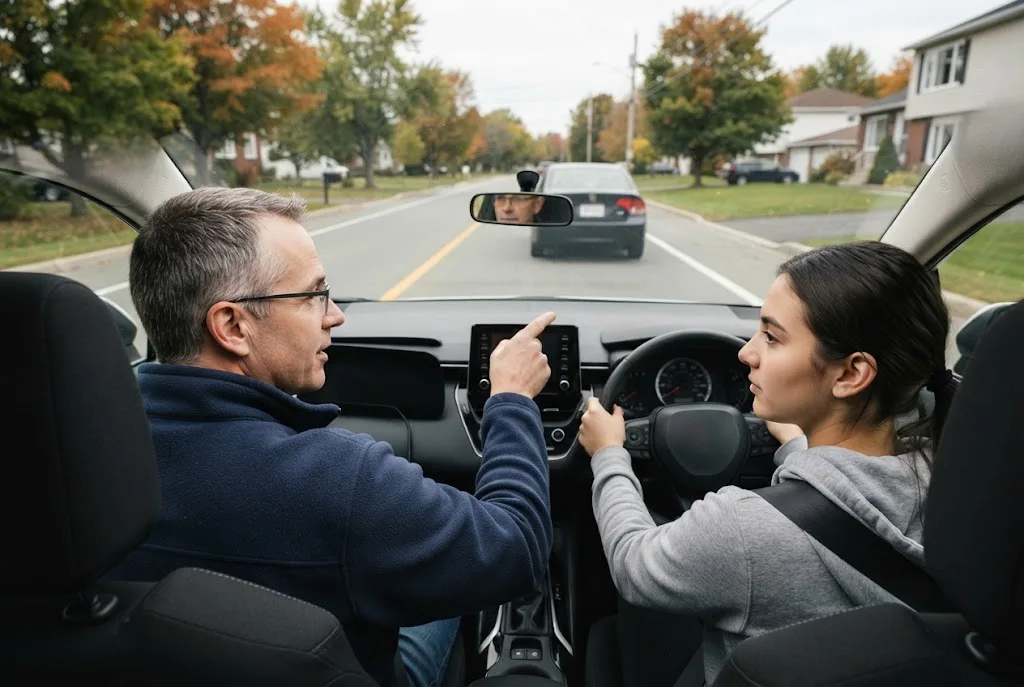
A learner may not always notice a recurring driving mistake. An instructor can observe the driver’s behavior from the passenger seat and identify areas that require improvement.
Useful feedback can involve vehicle positioning, observation habits, braking, steering, speed management, signaling, or decision-making.
Immediate feedback also gives learners an opportunity to correct mistakes before they become deeply established habits.
Choosing the Right Driver Education Program
Before enrolling in a driving course, prospective students should consider what type of instruction they actually need.
Ask About the Training Format
Find out how classroom and practical instruction are structured and whether the available program matches your licensing stage.
Check Instructor Qualifications
Professional driver education should be delivered by instructors who meet the applicable provincial requirements. New Brunswick separately regulates driver-training course licences and instructor permits.
Consider Your Learning Goals
A first-time learner may need a comprehensive program, while an experienced driver preparing for a road test may benefit more from targeted lessons.
Confirm Current Program Details
Course schedules, pricing, lesson availability, registration procedures, and program offerings can change. Always confirm current information before making an enrollment decision.
Vehicle Safety Is Part of Good Driving
Safe driving also depends on the condition of the vehicle.
Drivers should pay attention to tires, brakes, lights, mirrors, windshield visibility, steering, and other components that affect safe vehicle operation.
The New Brunswick Driver’s Handbook emphasizes that a vehicle needs to be maintained in good mechanical condition for safe operation. Driver education should therefore encourage learners to understand not only how to control a vehicle but also how vehicle condition affects safety.
Distraction Can Undermine Good Driving Skills
Even a well-trained driver can create unnecessary risk through distraction.
New Brunswick’s government guidance states that handheld-device use while driving is illegal and emphasizes that driving requires full attention. Preparing navigation, adjusting controls, and handling other tasks before moving can help keep attention where it belongs.
Developing the habit of putting the phone away is particularly important for new drivers because good habits formed early can become part of everyday driving behavior.
Preparing for New Brunswick Driving Conditions
New Brunswick drivers may encounter changing road and weather conditions throughout the year. Learners should understand that the same driving technique may not be appropriate in every situation.
Winter conditions can require lower speeds, greater following distances, appropriate tires, and additional preparation. The provincial government specifically advises drivers to prepare for winter conditions and adjust their driving to slippery roads and reduced visibility.
Drivers should also check current road and weather information when conditions may affect travel.
A&A Driver Education and the Moncton Area
A&A Driver Education is based in Dieppe and identifies the greater Moncton, Dieppe, Riverview, and surrounding communities as part of its service area.
The school’s official information states that it has provided driver education in the area since 1990 and offers training for beginners as well as experienced drivers.
Its stated approach centers on being alert and aware on the road, which aligns naturally with the broader principles of defensive driving and hazard awareness.
How to Get More Value From Driver Lessons
Students can make professional instruction more effective by actively participating in the learning process.
- Ask questions when a maneuver is unclear.
- Practice between scheduled professional lessons when legally permitted and appropriately supervised.
- Focus on correcting one or two recurring weaknesses at a time.
- Review road rules regularly.
- Pay attention to instructor feedback instead of focusing only on passing the test.
- Practice observation as much as vehicle control.
- Keep building skills after obtaining a licence.
The purpose of driver education should extend beyond a single examination. The habits developed during training can influence everyday driving long after the learner receives a licence.
Related Automotive and Road-Travel Resources
Learning to drive is one part of responsible vehicle ownership and road use. Readers interested in broader automotive topics can also explore FreshDell’s coverage of professional auto services and vehicle care.
For readers interested in longer-distance travel by car, FreshDell also covers scenic road trips around the world, offering a broader travel perspective beyond driver training.
Those interested in the business side of the automotive industry can also explore FreshDell’s article on automotive digital marketing.
Frequently Asked Questions About A&A Driver Education
Where is A&A Driver Education located?
A&A Driver Education lists its address as 451 Rue Paul in Dieppe, New Brunswick, Canada.
Who can take A&A Driver Education training?
A&A Driver Education states that it provides training for beginners as well as experienced drivers. Specific program eligibility should be confirmed with the school.
Does A&A Driver Education offer individual lessons?
The school describes individual evaluation and lesson options as part of its training offerings, including instruction that can help learners prepare for a road test or improve existing skills.
Does A&A Driver Education provide automatic-vehicle training?
Yes. The school’s official website lists automatic vehicles among its training offerings.
Does driver training matter in New Brunswick?
Driver training can provide structured instruction and practical experience. New Brunswick also states that completing a driver-training course can reduce the Level 1 waiting period before a road test from 12 months to eight months when the applicable requirements are met.
Is driver education only for teenagers?
No. Driver education can benefit first-time learners, adults learning to drive, experienced drivers seeking improvement, and people preparing for a road test.
What should I look for in a driving school?
Consider instructor qualifications, the structure of the program, practical training opportunities, scheduling, licensing requirements, and whether the course matches your specific learning needs.
Final Thoughts on A&A Driver Education
Effective driver education is about developing judgment as well as vehicle-control skills. Learners need to understand road rules, recognize hazards, manage the vehicle properly, and make responsible decisions when conditions change.
A&A Driver Education provides training for beginners and experienced drivers in the greater Moncton area, with programs designed around classroom knowledge and practical driver development. Its emphasis on being alert and aware provides a useful foundation for learning defensive driving habits.
For anyone considering professional driver training, the best starting point is to identify the skills they need, understand the applicable New Brunswick licensing requirements, and confirm the school’s current course options directly. Building strong habits during training can provide benefits that extend well beyond the road test.