
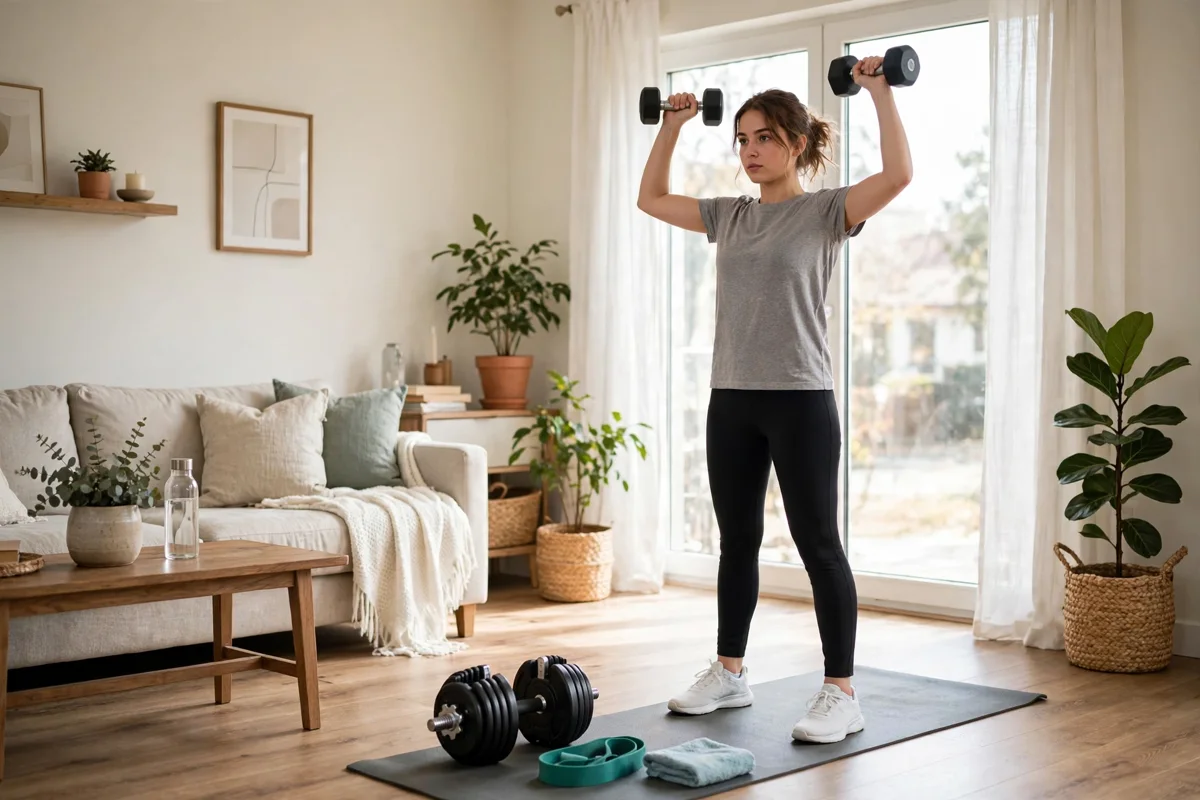
You do not need a gym membership, a rack of machines or a spare room full of iron to get stronger. Strength training at home for beginners works because the basic movement patterns are simple, the starting equipment list is short, and the first months of progress come from consistency rather than load. This guide explains how to set up a small training space, which exercises to learn first, and how to structure a week that a genuine beginner can actually sustain.
Why Strength Training at Home Works for Beginners
Early strength gains are mostly skill gains: your nervous system learns to recruit muscle efficiently long before the muscle itself grows much. That means bodyweight movements and light weights, done well and often, produce real results in the first months. Training at home removes the two biggest beginner barriers, travel time and self-consciousness, and replaces them with the one variable that matters most: showing up three times a week in your own living room.
The Minimal Equipment List
Start with less than you think. A pair of adjustable dumbbells or two fixed pairs, one light and one moderate, covers most beginner needs. Add a sturdy chair or step for support and elevation, a resistance band for rows and assistance work, and a mat if your floors are hard. That is genuinely enough for months of progress. Kettlebells, a pull-up bar and a bench are excellent later additions once the habit is established, but buying them first usually decorates a corner rather than building strength.
The Five Movements to Learn First
Build every session around five patterns. Squat: sit down to a chair and stand, progressing to goblet squats holding one dumbbell. Hinge: practise the hip hinge with a light Romanian deadlift pattern, keeping the back flat. Push: press-ups against a wall, then a counter, then the floor, and dumbbell floor presses. Pull: one-arm dumbbell rows supported on a chair, plus band rows. Carry and brace: farmer’s carries down a hallway and dead bugs or planks for the trunk. Master these five and every later exercise is a variation, not a mystery.
A Simple Three-Day Week for Strength Training at Home
Day one: squat pattern, press-up progression and one-arm rows, three sets each, resting as needed. Day two, after a rest day: hip hinge, floor press and carries, three sets each. Day three: repeat day one with small progressions, one extra repetition, slightly slower lowering, or the next step of an exercise variation. Keep sessions between 30 and 45 minutes. Write down what you did; the notebook is your coach, and adding a single repetition across a month is real, measurable progress.
Technique Rules That Prevent Injuries
Move slowly enough to own every position, especially the lowering phase. Stop a set when your form breaks down, not when you cannot move at all; the last clean repetition is the one that builds you. Warm up with five minutes of easy movement and a lighter rehearsal set of the first exercise. Joint pain is a stop signal, while ordinary muscle effort and next-day soreness are normal parts of adaptation. If a movement hurts sharply or repeatedly, change the variation, reduce the range, and if pain persists, get it checked rather than training through it.
How Progress Works After the First Month
Progress in strength training at home for beginners comes from small, boring increments: an extra repetition here, a slower tempo there, a slightly heavier dumbbell when the top of your repetition range feels comfortable twice in a row. Expect visible changes to lag behind strength changes; muscles respond over months, while the habit and the capability arrive in weeks. Fuelling supports the process more than beginners expect, so it is worth a glance at our piece on choosing more healthful snacks for the hours around training. Photographs and the training notebook tell the truth that the mirror and the bathroom scale often miss.
Staying Motivated When You Train Alone
Home training’s weakness is the absence of an audience. Counter it with structure: fixed training days treated like appointments, kit laid out the night before, and a visible calendar where each completed session earns its mark. Anchoring the session to an existing routine helps too; our morning routine ideas for energy and focus show how a training slot can ride on habits you already keep. A training partner or a community sports group adds the same gentle pressure, even if it starts with something as simple as choosing team names for your local sports side. Short sessions protect motivation better than heroic ones, because a finished 30 minutes builds the identity of someone who trains, while a skipped 90-minute plan builds the opposite. When motivation dips, shrink the session rather than skipping it; two exercises done honestly keep the chain unbroken, and chains, once long, are surprisingly hard to abandon.
What Normal Progress Feels Like
Expect the first fortnight to feel awkward and the first month to feel repetitive; that repetition is the mechanism, not a flaw in the plan. Soreness peaks early and fades as your body adapts to each movement, which is why new exercises should be introduced one at a time rather than all in the same week. By the end of the second month, most beginners notice everyday strength first: stairs feel shorter, shopping feels lighter, and the movements that wobbled in week one feel owned. Those quiet changes are the foundation every later programme is built on.
The Bottom Line
Strength training at home for beginners succeeds on simplicity: five movements, minimal equipment, three short sessions a week and patient, recorded progress. Skip the elaborate programme and the full equipment catalogue. Clear a corner, learn the patterns, and let consistency do the heavy work it is famous for.