

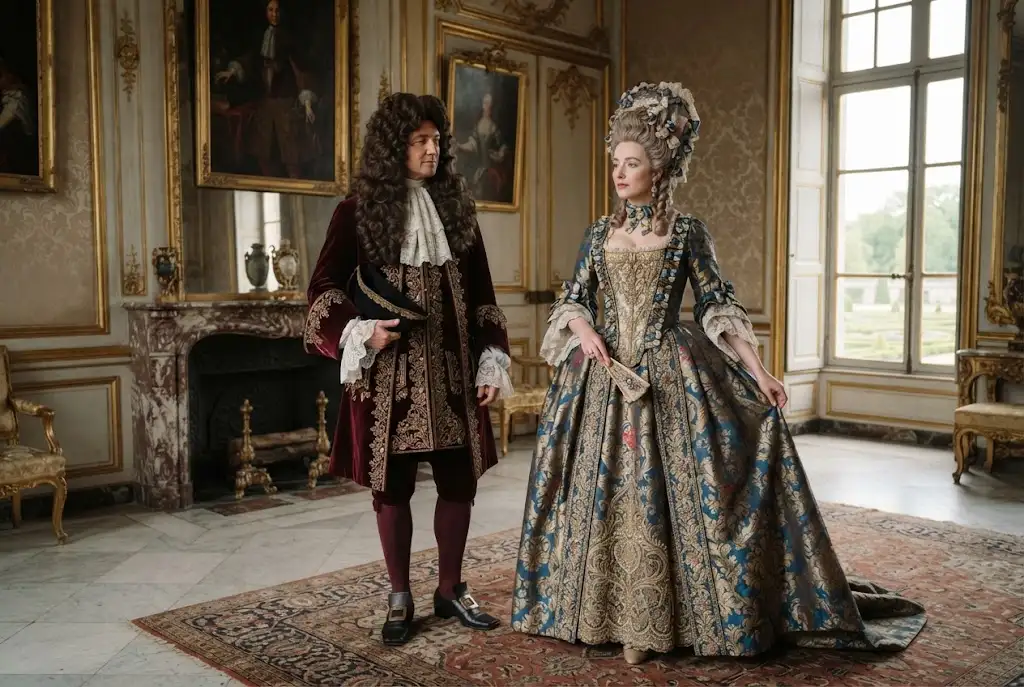
For women, the mantua became increasingly important, with gathered and trained skirts creating a distinctive silhouette. Men commonly wore the long justaucorps, fitted breeches, stockings, lace cravats, and large wigs. Rich silks, brocades, embroidery, ribbons, lace, and metallic decoration helped establish the unmistakably opulent appearance associated with the decade.
Understanding this period also provides useful context for the broader history of clothing and changing ideas about personal style. If you enjoy exploring fashion across different eras, you can also compare the period with modern subjects such as current fashion trends and modern street style looks.
What Defined 1680s Fashion?
The defining characteristic of 1680s fashion was the combination of structure and ornamentation. Clothing was designed to create a carefully controlled shape while also displaying expensive materials and detailed decoration.
Women’s clothing often emphasized the waist and created fullness around the skirt. Trains, contrasting underskirts, decorative stomachers, lace cuffs, ribbons, and embroidered details added visual complexity. Men’s clothing became more streamlined than some earlier 17th-century styles but remained highly decorative through textiles, buttons, lace, wigs, and accessories.
Fashion was also closely connected to social status. Expensive fabrics and skilled craftsmanship required substantial resources, meaning that elaborate clothing could communicate wealth, position, and proximity to fashionable court culture.
Women’s Fashion in the 1680s
Women’s dress underwent important changes during the decade. The mantua emerged as a major fashionable garment, while earlier structured gowns continued to appear. The resulting silhouette was elegant, elongated, and highly decorated.
The Mantua
The mantua was particularly significant because it helped create the characteristic bustle-like effect at the back of the gown. The outer fabric could be drawn backward over the hips, exposing a contrasting underskirt and producing a long train.
This arrangement made the underskirt much more visible than it had been in some earlier styles. As a result, the relationship between the outer gown and decorative petticoat became an important part of fashionable dressing.
The mantua also illustrates how historical clothing evolved gradually rather than changing overnight. Traditional bodices and separate skirts remained in use while the new gown style gained popularity.
Bodices and Stomachers
Bodices in the 1680s generally became somewhat more covering around the shoulders compared with earlier fashions. The front could feature a pointed stomacher decorated with embroidery, lace, metallic trimming, ribbons, or other embellishment.
The bodice helped establish the waistline while the skirt supplied fullness below it. Together, these components produced a silhouette that looked formal and carefully constructed.
Skirts, Petticoats, and Trains
Petticoats were an important part of women’s clothing during the decade. Because the mantua could be pulled back, the underskirt became a visible design feature rather than simply a hidden foundation.
Contrasting colors and rich fabrics could be used to make the petticoat stand out. Long trains added further drama to formal clothing, particularly among wealthy women and at court.
The emphasis on layered clothing also shows why historical fashion cannot be understood by looking at a single garment. The complete appearance depended on the combination of bodice, gown, petticoat, undergarments, footwear, hairstyle, and accessories.
Fabrics and Decoration in 1680s Clothing
Textiles played a major role in defining the luxurious appearance of the decade. Silk brocades were particularly important, and darker, richer colors became prominent in fashionable dress.
Metallic lace, embroidery, ribbons, fringe, bows, and other decorative elements could transform a relatively simple garment into a visually elaborate ensemble. Striped materials were also fashionable, sometimes arranged in contrasting vertical and horizontal directions.
Because fine fabrics were expensive, textiles themselves could represent considerable wealth. The secondhand market for valuable fabric also demonstrates how desirable these materials were beyond the wealthiest members of society.
The decorative principle has interesting parallels with later fashion movements. Modern wardrobes may use accessories to transform simple outfits, much like historical dress used ribbons, lace, embroidery, and jewelry to create a finished appearance. For a modern comparison, explore accessories that elevate an outfit.
1680s Hairstyles and the Fontange
Hair and headwear were essential components of fashionable appearance. As women’s silhouettes became more vertically oriented, hairstyles and headdresses also gained height.
The fontange became one of the most recognizable hairstyles associated with the late 17th century. It developed into a tall arrangement involving curled hair, lace, ribbons, fabric, and supporting structures.
The result could be remarkably elaborate. Rather than functioning simply as a hairstyle, the fontange became a major visual element of the complete outfit.
Historical hairstyles also demonstrate how fashion operates as a complete system. Clothing, hair, accessories, and proportions were designed to work together rather than being treated as completely separate choices.
For a broader look at hair and appearance in contemporary fashion, see the role of wigs in modern beauty and style.
Men’s Fashion in the 1680s
Men’s clothing in the 1680s centered on the justaucorps, a long coat that generally reached toward the knee. Compared with earlier styles, the garment developed a somewhat more shaped waist while maintaining a substantial overall silhouette.
Men commonly paired the coat with fitted breeches, stockings, a shirt, and a lace cravat. Large full-bottomed wigs became a defining feature of fashionable appearance.
The Justaucorps
The justaucorps was one of the most important garments of late 17th-century menswear. Its long shape created a formal appearance, while buttons, pockets, cuffs, and textile choices added detail.
Four vertical pockets became fashionable on some versions of the garment during the decade. The placement and arrangement of these practical details also contributed to the visual design of the coat.
Wigs and Cravats
Large wigs were highly visible elements of men’s fashion. The full-bottomed style created considerable volume around the head and shoulders, giving the upper body a distinctive proportion.
The lace cravat provided another important decorative detail. While lace remained present, men’s fashion increasingly favored a more controlled and serious appearance compared with some earlier extravagant styles.
If you are interested in how historical menswear contrasts with contemporary dressing, FreshDell’s coverage of iconic men’s shirts and clothing offers a modern point of comparison.
Colors and Patterns of the Era
Color and pattern were important components of 1680s dress. Darker shades and richly patterned silks were particularly associated with sophisticated formal clothing, while contrasting trims could create additional visual interest.
Striped textiles could be used in different orientations, while brocade patterns provided complex surfaces that caught the light. Metallic decoration added another layer of texture and reflected the period’s interest in luxurious presentation.
The result was not necessarily about using as many colors as possible. Instead, the visual impact often came from combining rich textiles with carefully positioned decoration.
Fashion and the Court of Louis XIV
The French court was an important center of fashion during the 1680s. Louis XIV’s court at Versailles helped establish French luxury culture as an influential force across Europe.
The development of the French silk industry and the prominence of Lyon as a silk-producing center contributed to the importance of high-quality textiles. Court culture also encouraged attention to clothing, presentation, and seasonal changes in fashionable materials.
This influence helps explain why 1680s fashion is often associated with elaborate French court dress. However, fashionable clothing was not identical everywhere. Regional traditions, social position, occupation, and economic circumstances all affected what people actually wore.
Everyday Clothing vs. Court Fashion
One of the easiest mistakes when studying 1680s fashion is assuming that everyone dressed like a royal court portrait. The clothing of ordinary people could be considerably more practical.
Working women, merchants, artisans, and members of the middle and lower social classes often wore simpler garments suited to their daily activities. Aprons, practical skirts, less elaborate bodices, and more restrained fabrics were common elements of everyday dress.
This distinction is important because surviving paintings and portraits can disproportionately represent wealthy people. Fashion history therefore requires looking beyond elite portraits and considering surviving garments, prints, written descriptions, and other evidence.
How 1680s Fashion Compared With Earlier 17th-Century Style
The 1680s did not appear in isolation. The decade inherited several trends from the 1660s and 1670s while developing new silhouettes.
Earlier in the century, women’s clothing could feature different skirt arrangements, bodice shapes, and decorative approaches. By the 1680s, the mantua and its trained silhouette were becoming increasingly important.
Men’s clothing likewise moved toward the long justaucorps, tighter breeches, stockings, wigs, and more controlled decoration. These changes helped establish the visual language that would continue into the 1690s.
For another perspective on how fashion changes over time, compare this historical period with FreshDell’s guide to building a capsule wardrobe, where modern clothing is approached through coordination and versatility rather than historical status and elaborate decoration.
Why 1680s Fashion Still Matters
The clothing of the 1680s remains relevant because it demonstrates how fashion can communicate far more than personal taste. Clothing could reveal wealth, social position, occupation, cultural influence, and connections to courtly trends.
The decade also shows how fashion is built through combinations. A gown was only one part of the appearance. The textile, silhouette, hairstyle, accessories, footwear, and decorative details all contributed to the final result.
That principle remains recognizable in modern style. Today’s outfits may be considerably simpler, but accessories, proportions, fabrics, layering, and styling still determine how an overall look is perceived.
1680s Fashion and Modern Historical Inspiration
Designers, costume creators, photographers, performers, and fashion enthusiasts can draw inspiration from historical clothing without reproducing an entire period wardrobe. Rich brocade textures, ribbon details, dramatic silhouettes, structured bodices, ornate accessories, and elaborate hairstyles can all influence contemporary styling.
The key is understanding the original context. A historical-inspired outfit becomes more convincing when its silhouette, materials, and decorative details are considered together rather than simply adding one old-fashioned accessory to an otherwise modern outfit.
For readers interested in fashion inspiration across different styles, FreshDell also explores modern saree trends, faith-inspired fashion, and purpose-driven clothing style.
Frequently Asked Questions About 1680s Fashion
What did women wear in the 1680s?
Women commonly wore structured bodices, skirts or mantua gowns, petticoats, stockings, and decorative accessories. Wealthier clothing could feature silk brocade, embroidery, lace, ribbons, metallic trimming, and long trains.
What was the mantua in 1680s fashion?
The mantua was a fashionable gown that became increasingly prominent during the late 17th century. Its fabric could be drawn back over the hips, creating a bustle-like effect and exposing a decorated underskirt.
What did men wear in the 1680s?
Men commonly wore long justaucorps coats, fitted breeches, stockings, shirts, lace cravats, shoes, and large full-bottomed wigs. Decorative details varied according to social status and occasion.
What fabrics were popular in the 1680s?
Silk and rich brocade fabrics were particularly important in fashionable dress. Lace, embroidery, ribbons, metallic decoration, and other trims were used to enhance garments.
What hairstyle was popular in the 1680s?
The fontange became an important women’s hairstyle and headdress during the period, while men commonly wore large full-bottomed wigs.
Was 1680s clothing always extremely elaborate?
No. Court clothing and wealthy fashion could be highly elaborate, but everyday clothing varied according to occupation, social class, location, and economic circumstances.
From Historical Elegance to Modern Style
Fashion in the 1680s offers a fascinating example of how clothing can reflect culture, economics, craftsmanship, and social identity. The mantua, justaucorps, brocade textiles, lace, ribbons, wigs, and elaborate hairstyles created a distinctive visual language that remains recognizable centuries later.
Its influence can also be appreciated by comparing historical fashion with modern trends. From fast-moving fashion trends to practical wardrobe planning and affordable fashion shopping, modern clothing continues to evolve through changes in materials, culture, lifestyle, and consumer preferences.
Exploring periods such as the 1680s makes it easier to see that fashion has never been simply about clothes. It is also a record of the people, industries, values, and creative choices that shaped each era.
For more fashion-related exploration, visit the FreshDell fashion and lifestyle collection.