

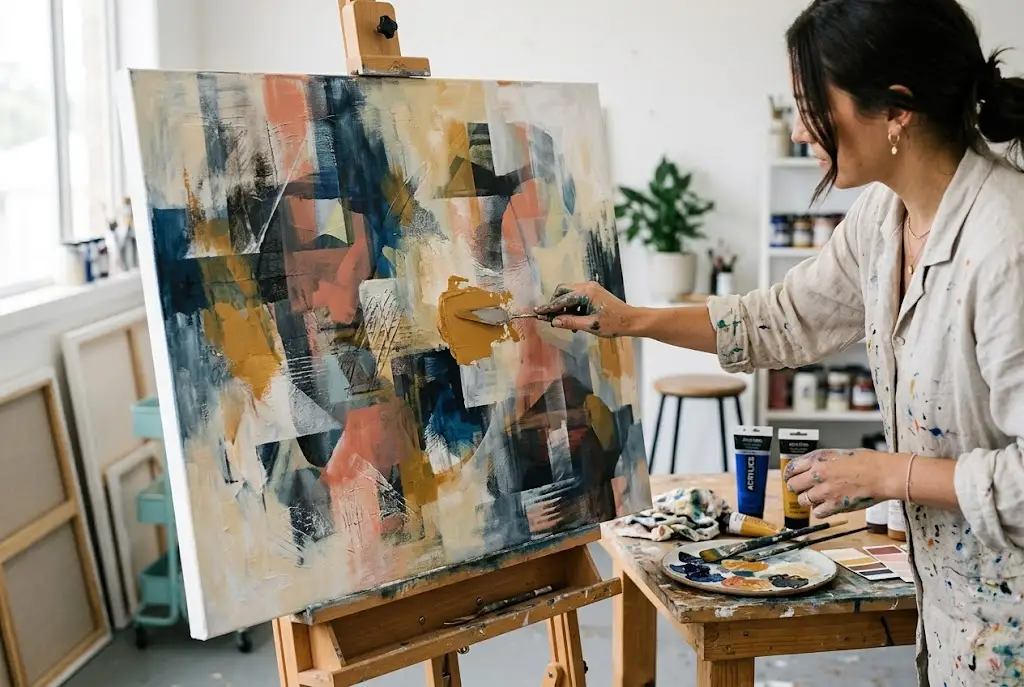
Abstract art gives artists the freedom to work beyond literal representation and explore color, shape, line, texture, movement, and emotion. Instead of asking an artist to reproduce a person, place, or object realistically, abstraction opens the door to interpretation and experimentation.
That freedom can be exciting, but it can also make a blank canvas feel intimidating. The good news is that abstract painting does not require one fixed method. You can build a composition through layered color, expressive marks, geometric shapes, fluid paint, texture, collage, or a combination of several approaches.
This guide explores practical abstract art techniques and ideas for beginners and experienced creatives who want to experiment, develop a visual language, and create more intentional abstract work.
What Is Abstract Art?
Abstract art moves away from the goal of accurately representing recognizable objects. Artists may simplify, distort, fragment, or completely remove recognizable subjects and instead emphasize visual elements such as color, form, line, texture, scale, and composition.
There is no single abstract style. Some artists work with carefully organized geometric forms, while others create energetic compositions through spontaneous gestures. Some focus almost entirely on color relationships, while mixed-media artists build meaning through layers of paint, paper, fabric, marks, and found materials.
For beginners, this makes abstraction particularly useful as a space for experimentation. You can focus on making decisions about the canvas without worrying about whether a realistic drawing looks accurate.
Why Experiment With Abstract Art?
Abstract painting can help you become more aware of the basic building blocks of visual art. Color, contrast, rhythm, balance, texture, and negative space all become active choices rather than background details.
It also encourages iteration. A mark that looks wrong at first can become useful when another layer is placed over it. A color combination that seems too strong may create exactly the contrast a composition needs.
Learning different painting techniques gives you a practical vocabulary for making those decisions. The University of the Arts London similarly emphasizes that understanding fundamental painting techniques can help artists experiment with different styles and develop their own visual voice.
If you are looking for a broader creative starting point, you can also explore ways to unlock your inner artist and approach abstraction as part of a wider creative practice.
Essential Abstract Art Techniques to Try
1. Layered Color Washes
Begin with diluted acrylic paint or another fluid medium and spread transparent layers across the surface. Allow portions of the underlying color to remain visible as new layers are added.
This technique creates depth without requiring complicated drawing. You can change the direction of your brushwork, introduce water into wet paint, or allow colors to overlap naturally.
Layering is especially useful when you want an atmospheric composition rather than a hard-edged design.
2. Palette Knife Painting
A palette knife creates a completely different surface from a traditional brush. You can drag thick paint across the canvas, scrape it away, create ridges, or place sharp blocks of color beside softer passages.
Try varying the amount of paint on the knife. A thin layer can reveal the surface underneath, while a heavier application can create pronounced texture.
3. Expressive Mark-Making
Mark-making is one of the simplest ways to make an abstract painting feel personal. Use brushes, charcoal, crayons, oil sticks, pencils, or other tools to create lines and marks with different weights and rhythms.
Experiment with fast strokes, slow strokes, broken lines, dots, loops, scratches, and repeated gestures. The objective is not to make every mark attractive. Instead, look at how individual marks interact with the larger composition.
Varying marks can create rhythm and visual movement, while repeated marks can establish relationships between different areas of the canvas.
4. Dripping and Pouring
Fluid paint can be allowed to move across the canvas rather than being completely controlled by a brush. Tilt the surface, add drops of contrasting color, or let paint travel through gravity.
The results can range from subtle flowing patterns to energetic compositions. Start with a limited palette so the movement remains visually coherent.
Research into the physical behavior of artistic paint has also examined how viscosity, flow, and instability can contribute to patterns and textures in painting.
5. Dry Brushing
Use a relatively small amount of paint on a dry brush and lightly drag it across the surface. This can create broken, scratchy passages where the texture of the canvas remains visible.
Dry brushing works well when you want to contrast heavily painted areas with quieter sections.
6. Scraping and Subtractive Painting
Abstract art does not have to be created only by adding material. Scraping or wiping paint away can reveal earlier layers and introduce unexpected shapes.
Try applying several colors, allowing them to partially dry, and then removing selected areas with a scraper or cloth. The resulting surface can feel much more complex than a single layer of paint.
7. Geometric Abstraction
Use circles, rectangles, triangles, grids, arcs, or irregular geometric forms to organize the canvas. Geometric abstraction can be highly structured, but it does not have to feel rigid.
Experiment with scale. Place one oversized shape against several smaller forms, or allow a geometric element to extend beyond the edge of the canvas.
Pay particular attention to negative space. The empty areas between shapes are part of the composition and can determine whether the finished work feels crowded or balanced.
8. Collage and Mixed Media
Combine paint with paper, printed material, fabric, pencil, charcoal, or other suitable media. Collage introduces physical layers and can provide visual information that would be difficult to achieve with paint alone.
Try tearing paper rather than cutting it perfectly. Place fragments at different angles, partially cover them with paint, and allow selected pieces to remain visible.
9. Pattern and Repetition
Repetition can create rhythm across an abstract composition. A repeated line, symbol, shape, or brush gesture can connect separate areas of the canvas.
You do not need to make every repeated element identical. Small variations can keep the surface organic while maintaining a recognizable visual relationship.
10. Glazing
Glazing involves building thin transparent layers of color over a dry surface. Each layer can subtly alter what lies underneath and create greater depth in selected areas.
This technique rewards patience. Instead of trying to achieve the final color immediately, build it gradually and observe how each layer changes the surface.
How to Choose Colors for Abstract Art
Color can become the central subject of an abstract painting. Rather than choosing colors randomly, start with a simple relationship between a few colors.
Use a limited palette
Working with three to five major colors can make it easier to maintain harmony. You can then introduce lighter, darker, warmer, or cooler variations of those colors.
Create contrast
Contrast can come from light versus dark, warm versus cool, saturated versus muted, or complementary colors. Strong contrast draws attention and can establish a visual focal point.
Let one color dominate
Choosing a dominant color gives the painting an overall visual identity. Supporting colors can then be used more selectively to create variation and emphasis.
Test combinations first
Before covering the entire canvas, test several combinations on scrap paper or a small practice surface. This can help you identify muddy combinations before they become difficult to correct.
Abstract Art Ideas for Your Next Painting
Sometimes the hardest part is not choosing a technique but deciding what to paint. Instead of waiting for a perfect idea, use a simple creative prompt.
- Paint a memory: Think about a place, moment, or atmosphere and translate its colors and movement rather than painting the scene literally.
- Respond to music: Choose one song and let its rhythm influence your marks, colors, and composition.
- Paint an emotion: Assign colors and gestures to an emotion such as calm, tension, excitement, nostalgia, or uncertainty.
- Abstract a photograph: Select a photograph and reduce it to a few major shapes and colors.
- Use nature as inspiration: Look at clouds, rocks, leaves, water, or landscapes and extract patterns rather than copying them.
- Work with one shape: Choose a circle, square, triangle, or organic form and explore how many variations you can create.
- Create a texture study: Build an entire composition around rough, smooth, scratched, layered, or raised surfaces.
- Paint with restrictions: Limit yourself to two colors, one brush, or a small canvas and see how the restriction changes your decisions.
For additional creative inspiration, explore the role of creativity in problem-solving and consider how experimentation can lead to unexpected solutions.
A Simple Abstract Painting Process for Beginners
You do not need a complicated formula to begin. A basic process can give you enough structure while still leaving room for experimentation.
Step 1: Choose an idea
Start with an emotion, memory, photograph, sound, color combination, or simple visual prompt.
Step 2: Select a limited palette
Choose a few colors that support your idea. Add white, black, or neutral tones if you need to adjust value and contrast.
Step 3: Establish the first layer
Cover portions of the surface with broad shapes, washes, or loose marks. Do not worry about finishing details at this stage.
Step 4: Add structure
Introduce stronger lines, shapes, patterns, or areas of contrasting color. Look for relationships between different parts of the canvas.
Step 5: Build texture
Use palette knives, dry brushing, scraping, collage, or other techniques to create surface variation.
Step 6: Step back
View the painting from a distance. Look for areas that attract too much attention, sections that feel empty, and places where the eye naturally moves.
Step 7: Edit instead of endlessly adding
One of the most useful abstract painting skills is knowing when to stop adding. If the composition becomes crowded, remove or cover selected areas instead of automatically adding another layer.
How to Create Better Abstract Compositions
Freedom does not mean that composition becomes irrelevant. Even highly spontaneous abstract work benefits from intentional relationships between elements.
Balance
Balance does not necessarily mean symmetry. A large dark shape on one side may be balanced by several smaller lighter shapes elsewhere.
Hierarchy
Give the viewer somewhere to look first. You can establish hierarchy through contrast, size, saturation, texture, or unusual marks.
Rhythm
Repeated shapes, colors, and gestures can guide the eye around the canvas. Rhythm can be regular or deliberately irregular.
Negative space
Empty areas provide breathing room. If every part of the canvas has the same visual intensity, the composition can become difficult to read.
Variation
Contrast smooth and rough surfaces, large and small shapes, soft and hard edges, and quiet and energetic passages. Variation keeps the viewer engaged.
Common Mistakes to Avoid
Experimentation is part of abstract art, but a few habits can make the process unnecessarily difficult.
- Using too many colors: A large palette can quickly become visually chaotic.
- Adding without editing: More paint does not automatically make a painting stronger.
- Ignoring the whole canvas: Focusing only on individual details can make the overall composition unbalanced.
- Repeating one mark everywhere: Consistency can create rhythm, but too much repetition may flatten the composition.
- Fear of covering mistakes: An unsuccessful area can become useful under another layer.
- Trying to finish too quickly: Some techniques, especially layered and transparent approaches, benefit from drying time and reflection.
Abstract Art Materials for Beginners
You can begin without purchasing an extensive studio setup. A practical starter collection might include:
- Acrylic paint in a small selection of colors
- Several brushes with different shapes and sizes
- A palette or disposable mixing surface
- Canvas, canvas board, or heavy mixed-media paper
- A palette knife or plastic scraper
- Water container for acrylic work
- Paper towels or reusable cloths
- Pencil, charcoal, or drawing tools for mark-making
- Optional collage materials
If you work with oils, solvents and mediums require additional safety considerations and proper ventilation. Choose materials according to the medium you understand and can use safely.
How to Find Your Own Abstract Style
Developing an artistic style usually takes repeated experimentation rather than a single breakthrough. Pay attention to the choices you naturally return to.
Do you prefer muted colors or intense contrasts? Do you repeatedly make sweeping gestures or geometric shapes? Are you more interested in texture, color, symbolism, or movement?
Keep a visual record of your experiments. Photograph finished pieces and note the materials and techniques you used. Over time, patterns in your preferences can reveal the beginnings of a personal visual language.
You can also revisit the same idea using different techniques. Paint the same emotional concept with a palette knife, then with fluid washes, then through collage. Comparing the results can show you which processes feel most natural.
Frequently Asked Questions About Abstract Art
Do you need to know how to draw to create abstract art?
No. Drawing skills can certainly help with some forms of abstraction, but abstract art can be built primarily through color, shape, texture, line, and composition. The emphasis is on visual decisions rather than realistic reproduction.
What is the easiest abstract painting technique for beginners?
Layered acrylic washes, simple mark-making, palette knife work, and geometric shapes are approachable starting points. Begin with one technique rather than trying everything on your first canvas.
How do I get ideas for abstract paintings?
Use memories, music, emotions, photographs, nature, architecture, color combinations, or everyday observations as starting points. The goal is to translate an experience into visual elements rather than simply copy the source.
How many colors should I use in an abstract painting?
There is no fixed number, but a limited palette is often easier to control. Starting with three to five main colors can help you understand how they interact before you introduce additional hues.
When should I stop an abstract painting?
Stop when additional marks no longer improve the composition. Step away from the canvas, view it from different distances, and consider whether the visual hierarchy, balance, and overall energy feel intentional.
Final Thoughts
Exploring abstract art is less about finding one perfect technique and more about developing the confidence to experiment. Washes, palette knives, expressive marks, scraping, geometric forms, collage, pattern, and glazing can all become useful parts of your creative vocabulary.
The strongest starting point is simple: choose an idea, limit your palette, make a few intentional marks, and respond to what happens on the canvas. Over time, repeated experimentation can help you discover which colors, textures, gestures, and compositions feel most like your own.
Abstract art does not require you to know exactly where a painting will end before you begin. Sometimes the most interesting work appears when a clear starting idea meets an open mind and a willingness to change direction.