

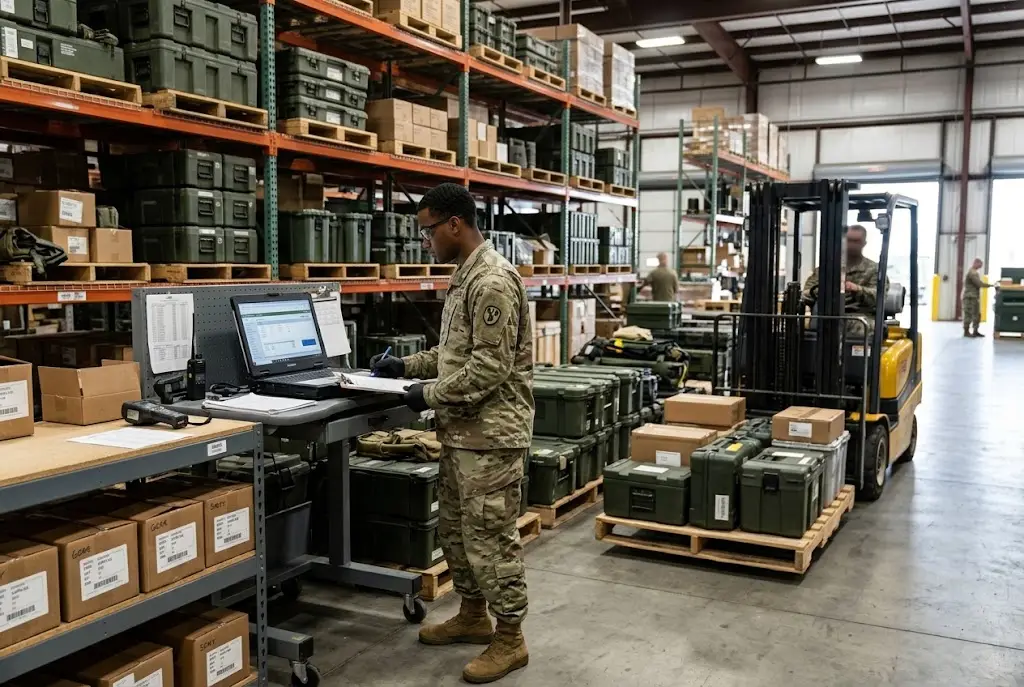
Although the job involves physical warehouse work, it is not limited to moving boxes. A 92A can work with inventory records, automated logistics systems, shipping documents, equipment parts, material-handling equipment, stock control, and supply reports. The Army’s current career guidance describes 92A duties across receiving, storage, distribution, inventory management, accounting, and logistics systems. The U.S. Army’s official 92A career page also identifies the MOS as an enlisted logistics specialty.
This guide explains what a 92A does, how the role supports military supply chains, what training is involved, which skills matter, and how the experience can translate into broader logistics and supply-chain careers.
What Is a 92A Automated Logistical Specialist?
92A is the Army’s MOS designation for an Automated Logistical Specialist. The role combines warehouse management, inventory control, equipment records, supply accounting, and automated logistics processes.
According to current Army career guidance, 92A Soldiers perform maintenance-management and warehouse functions while maintaining equipment records and improving the quality and accuracy of maintenance, cost, and parts data.
The Army’s current CMF 92 career progression guidance further describes responsibilities such as maintaining stock records, reviewing shipping documentation, receiving and inspecting supplies, storing equipment, operating material-handling equipment, and selecting stock for issue.
What Does a 92A Do?
The day-to-day responsibilities of a 92A can vary depending on the unit, assignment, rank, and operational environment. However, the core mission remains centered on keeping supplies and equipment properly accounted for and available when needed.
Receiving Supplies and Equipment
92A Soldiers may receive incoming supplies and equipment and compare the shipment against relevant documentation. This can include bills of lading, contracts, purchase requests, and shipping documents.
The Army’s career progression plan specifically identifies reviewing quantities received, unloading and unpacking shipments, visually inspecting items, counting materials, segregating supplies, and placing equipment into storage as core duties.
Managing Inventory
Inventory accuracy is one of the most important responsibilities within logistics. A 92A helps maintain records showing what supplies are available, where they are located, and what has been issued or received.
Accurate inventory information helps commanders and logistics personnel make better decisions about replenishment, distribution, and readiness.
Storing and Issuing Supplies
After materials are received and processed, they must be stored correctly and made available to authorized units or personnel when requested.
92A Soldiers may select the correct stock for issue, prepare items for distribution, and maintain the documentation associated with those transactions. Army training materials also describe 92A Soldiers processing requests, turn-ins, inventories, and prescribed-load-list functions.
Maintaining Equipment Records
Equipment records provide an important link between physical assets and the Army’s logistics information systems. A 92A may maintain records involving parts, equipment, maintenance data, inventory, and supply transactions.
This administrative side of the job is one reason the MOS can develop skills that extend beyond traditional warehouse work.
Operating Material-Handling Equipment
Depending on the assignment and qualifications, 92A Soldiers may operate material-handling equipment (MHE) used to move supplies and equipment safely within logistics facilities.
The Army’s career guidance specifically lists MHE operation among 92A duties.
How Does a 92A Support Military Supply Chains?
Military logistics is fundamentally about making sure the right resources reach the right location at the right time. A 92A contributes to that process at the warehouse and supply-management level.
A simplified logistics cycle can look like this:
- Supplies or equipment arrive at a logistics facility.
- Personnel verify the shipment against documentation.
- Items are inspected and recorded.
- Materials are stored in appropriate locations.
- Units submit supply requests.
- Authorized items are selected and prepared for issue.
- Supplies are distributed to supported units.
- Transactions and inventory records are updated.
The 92A role can therefore affect multiple stages of the supply process. A mistake in receiving, inventory, storage, or issuing can create problems farther down the chain.
Army reporting on supply-support activities has specifically highlighted 92A processing as part of the flow from arriving supplies through warehouse placement and eventual issue to supported units.
92A Training and Requirements
The Army’s current 92A career page identifies the MOS as an entry-level enlisted specialty and lists 10 weeks of Basic Combat Training followed by 9 weeks of Advanced Individual Training (AIT). It also lists a minimum ASVAB requirement of 90 in the Clerical (CL) area for the MOS.
The Army’s general eligibility requirements can also include citizenship or permanent-resident status, age requirements, education, medical qualifications, and other enlistment standards. Because enlistment requirements can change, applicants should verify current requirements directly with the Army rather than relying on an older job description.
Basic Combat Training
Like other enlisted Soldiers, a new 92A begins with Basic Combat Training. This establishes foundational military skills, physical readiness, discipline, teamwork, and Soldier tasks.
Advanced Individual Training
After basic training, the Soldier moves into job-specific training. The 92A training pipeline focuses on the knowledge and skills required to perform automated logistics and supply-management duties.
Army training documentation has historically included instruction involving supply requests, turn-ins, inventories, shipping documentation, RFID technology, material-handling equipment, and automated logistics systems.
What Skills Does a 92A Need?
Attention to Detail
Inventory and supply work depends on accuracy. A small discrepancy in a record, quantity, stock number, or location can create downstream problems.
Organization
A logistics specialist may need to track numerous items and transactions. Good organization helps prevent misplaced supplies, incomplete records, and unnecessary delays.
Computer and Data Skills
Despite the physical aspects of warehouse work, modern logistics depends heavily on automated systems and accurate data. The Army’s 92A career information specifically highlights record keeping and automated logistics functions.
Physical Readiness
Some assignments involve lifting, carrying, loading, unloading, and operating equipment. Soldiers must also meet the Army’s physical readiness requirements.
Communication
92A Soldiers interact with other logistics personnel, supported units, supervisors, maintenance teams, and commanders. Clear communication helps ensure that supply requirements are understood and completed correctly.
Problem-Solving
Supply operations do not always go according to plan. Missing documentation, inventory discrepancies, unexpected demand, damaged items, or transportation delays can require quick and organized problem-solving.
92A and Automated Logistics Systems
The word “Automated” in the MOS title is significant. The job involves more than manually counting and moving supplies.
Army logistics relies on information systems to track materials, transactions, equipment, and supply requirements. Current Army career documentation identifies automated supply applications and logistics-system proficiency as important parts of 92A development.
Army career guidance also identifies Global Combat Support System-Army (GCSS-Army) training within the 92A development path.
This combination of physical logistics and digital record management makes the MOS particularly relevant to modern supply-chain operations.
Where Can a 92A Soldier Work?
A 92A can serve in different logistics environments depending on the unit and assignment.
Army career documentation identifies operational assignments such as:
- Equipment records and parts specialist.
- Materiel control and accounting specialist.
- Materiel storage and handling specialist.
- Material-handling equipment operator.
- Packing and crating specialist.
- Supply accounting specialist.
- Subsistence supply specialist.
- Stock accounting specialist.
- Vehicle operator.
These assignments demonstrate that 92A is broader than a single warehouse position.
92A Career Progression
As Soldiers gain experience and move into leadership positions, their responsibilities can expand from individual supply tasks to supervision, planning, inventory management, and logistics operations.
The Army’s current CMF 92 career progression material describes advanced 92A responsibilities including supervising inventories and location surveys, instructing warehouse personnel, reviewing requests for major and controlled items, recommending stocking-list changes, and performing financial-management functions.
At higher levels, 92A personnel can serve in positions such as supply advisor, materiel control supervisor, operations NCO, logistics service NCO, procurement NCO, platoon sergeant, instructor, and training developer.
Certifications and Additional Training
The 92A career path can include additional military education and credentials beyond the core MOS training.
The Army’s career progression guidance lists opportunities that can include Air Assault, Battle Staff, Jumpmaster, Master Driver Trainer, Operational Contracting Support, and other additional skill identifiers or qualifications, depending on eligibility and assignment.
The same career guidance encourages Soldiers to pursue appropriate civilian credentials as part of professional development.
The specific courses available to an individual Soldier will depend on eligibility, assignment, Army requirements, and available opportunities.
92A Skills That Transfer to Civilian Careers
One of the major advantages of logistics experience is that many of the underlying skills have civilian equivalents.
Warehouse Operations
Experience with receiving, storage, inventory, picking, issuing, and material handling can translate into warehouse and distribution roles.
Inventory Management
Maintaining accurate stock records is relevant to inventory-control positions in manufacturing, retail, distribution, healthcare, and other industries.
Supply Chain Operations
Understanding how materials move through receiving, storage, distribution, and fulfillment can provide a foundation for broader supply-chain careers.
Logistics Coordination
Experience coordinating supply requirements, documentation, transportation, and distribution can be useful in logistics coordinator and operations roles.
Data and Systems
Experience working with automated logistics systems can demonstrate that a candidate is comfortable using technology to track physical assets and operational information.
Possible Civilian Career Paths After 92A
A former 92A Soldier may consider civilian roles such as:
- Warehouse supervisor.
- Inventory control specialist.
- Logistics coordinator.
- Supply chain specialist.
- Materials management specialist.
- Distribution center supervisor.
- Procurement support specialist.
- Operations coordinator.
- Fleet or parts management specialist.
- Warehouse operations manager.
The best fit depends on the Soldier’s actual duties, leadership experience, education, certifications, and ability to translate military terminology into civilian business language.
Why Accuracy Matters in Military Logistics
Logistics errors can have consequences beyond an ordinary warehouse discrepancy. Military units depend on supplies and equipment to maintain readiness and accomplish assigned missions.
That is why inventory accountability, documentation, proper storage, and timely distribution are essential parts of the 92A mission.
Army examples demonstrate the operational importance of this work. At Fort Buchanan in 2026, a 92A Soldier was involved in ration-support operations through a Supply Support Management Office, with Army officials describing the service as helping streamline distribution and improve sustainment.
How Technology Is Changing Military Logistics
Military logistics is increasingly data-driven. Automated systems can help organizations understand inventory levels, demand, resource availability, and distribution requirements.
The broader Army is also investing in data-driven supply-chain concepts. In November 2025, the Army described a new personnel supply-chain management framework using data, forecasting, automation, and AI to improve personnel-flow planning.
For 92A Soldiers, this broader technological direction reinforces the importance of accurate data entry, automated systems, inventory visibility, and analytical thinking alongside traditional warehouse skills.
Is 92A a Good Army MOS?
Whether 92A is a good MOS depends on the Soldier’s interests and career goals. It can be a strong fit for someone who enjoys logistics, organization, hands-on work, technology, inventory management, and operational problem-solving.
The MOS can also provide experience that translates into civilian supply-chain and logistics careers. Soldiers who deliberately build leadership, technical, and credentialing experience may have more options as they progress.
However, the work can be physically demanding and detail-intensive. Soldiers should also understand that assignments vary, and not every 92A position will provide the same daily experience.
Tips for Succeeding as a 92A
- Master inventory accuracy: Treat every transaction and record as important.
- Learn the systems: Become comfortable with the Army’s automated logistics tools used in your assignment.
- Understand the entire supply process: Learn how receiving, storage, issue, turn-in, transportation, and accountability connect.
- Develop leadership skills: Strong communication and supervision become increasingly important as responsibilities grow.
- Keep documentation organized: Good records support accountability and make problems easier to identify.
- Pursue useful credentials: Take advantage of relevant Army training and civilian credentialing opportunities when available.
- Learn civilian terminology: If you plan to transition, understand how your military experience maps to commercial logistics language.
Related Logistics and Supply Chain Topics
FreshDell’s sitemap includes several logistics-focused articles that can provide additional context around supply chains and modern distribution. Readers can explore FJ Carrier Logistics for another perspective on supply-chain efficiency, as well as DRF Logistics for logistics operations involving speed, precision, and reliability.
The site also covers logistics parks and modern warehousing, providing a useful civilian comparison with the warehouse and distribution principles that 92A specialists work with in military environments. These pages help connect military logistics concepts with broader supply-chain operations.
Frequently Asked Questions About 92A
What does 92A mean in the Army?
92A is the Military Occupational Specialty code for Automated Logistical Specialist. The MOS focuses on supply, warehouse, inventory, equipment records, and logistics-management functions.
What does a 92A Automated Logistical Specialist do?
A 92A may receive, inspect, store, account for, and issue supplies and equipment. The role can also involve inventory records, shipping documentation, automated logistics systems, material-handling equipment, and supply reports.
How long is 92A AIT?
The Army’s current GoArmy career page lists 9 weeks of Advanced Individual Training for 92A, following 10 weeks of Basic Combat Training.
What ASVAB score is needed for 92A?
The current GoArmy page lists a 90 Clerical (CL) score requirement. Requirements can change, so applicants should confirm current standards with the Army.
Can 92A experience help with civilian jobs?
Yes. Skills involving inventory control, warehouse operations, supply management, equipment records, logistics coordination, and automated systems can transfer to civilian logistics and supply-chain positions.
Is 92A only a warehouse job?
No. Warehouse operations are important, but the MOS also involves inventory management, documentation, automated systems, supply accounting, equipment records, and logistics coordination.
Final Thoughts
The 92A Automated Logistical Specialist plays an important role in keeping military supply operations organized, accountable, and responsive. From receiving and storing equipment to maintaining records and issuing supplies, the MOS connects physical materials with the information systems needed to manage them.
The role has also evolved alongside modern logistics technology. Today’s 92A Soldiers work with automated systems and data while still performing the practical warehouse and material-handling tasks that keep supplies moving.
For Soldiers considering their long-term careers, the MOS can provide a valuable foundation in inventory control, warehouse management, supply-chain operations, logistics coordination, and leadership. With deliberate skill development and relevant credentials, those experiences can also support a transition into civilian logistics and supply-chain careers.
Ultimately, the strength of 92A lies in its combination of operational discipline, technical systems, inventory accountability, and real-world logistics experience.