

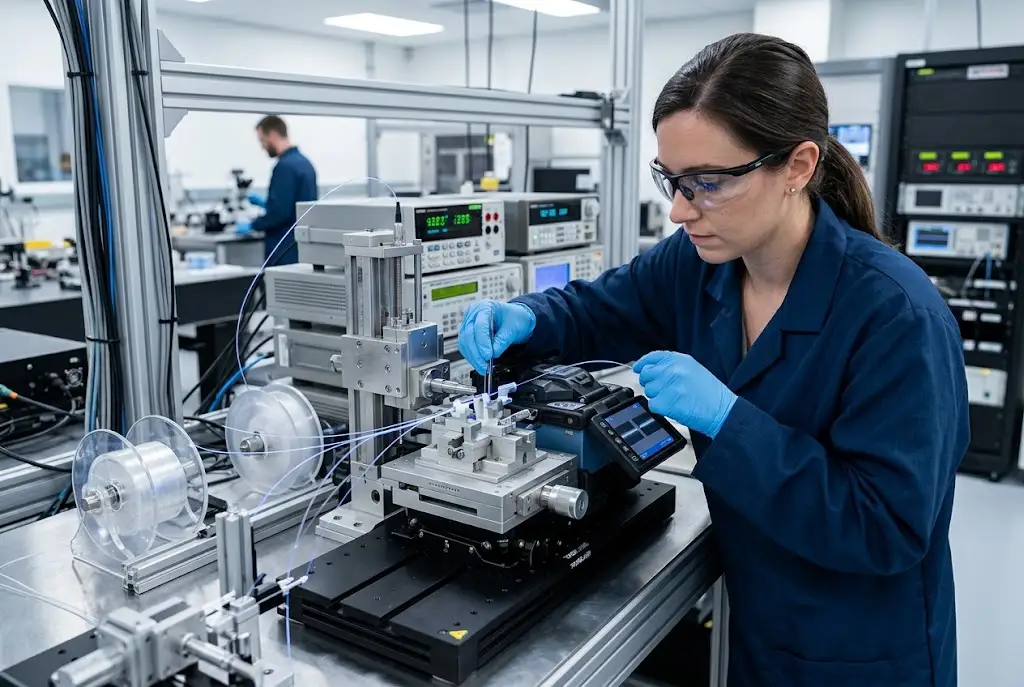
3SAE Technologies Inc. is a Franklin, Tennessee-based technology company specializing in advanced fiber optic tools, fusion splicing, glass processing, fiber preparation, testing, and related photonics technologies. Its products and engineering capabilities serve specialized markets including telecommunications, medical applications, aerospace and defense, fiber optic lasers, manufacturing, oil and gas, sensors, and academia.
Its portfolio includes fusion splicers, glass processing systems, fiber preparation tools, test equipment, recoaters, multi-axis positioning technology, and custom engineering services. The company also develops technologies such as its Wide Area Plasma Technology™, known as Ring of Fire®, and the PentaPod® multi-axis positioner.
What Is 3SAE Technologies Inc.?
3SAE Technologies Inc. is an American photonics technology company headquartered in Franklin, Tennessee. The company specializes in developing tools and technologies for optical fiber preparation, fusion splicing, glass processing, and related applications.
According to the company’s profile, 3SAE has operated for nearly 25 years and has developed multiple patented technologies while adapting its products to changing requirements within the fiber optics industry. Its solutions are used by photonics companies, research organizations, universities, government laboratories, and specialized manufacturing facilities.
The company’s focus is highly specialized: instead of treating fiber optics simply as a communications medium, 3SAE develops equipment for processing and manufacturing the optical components that make advanced photonic systems possible.
Why Fiber Optic Technology Matters
Fiber optics has become fundamental to modern communications, sensing, scientific research, medical technologies, and high-power laser systems. Optical fibers can transmit light efficiently over long distances and can also be engineered for highly specialized applications.
However, producing and processing specialty optical fibers requires considerably more than simply installing a cable. Fibers may need to be stripped, cleaned, cleaved, spliced, tapered, recoated, tested, aligned, or processed into specialized assemblies.
This is where companies such as 3SAE Technologies become important. Precision processing equipment helps manufacturers and researchers control the physical characteristics of optical fibers and fiber-based components.
3SAE’s Core Technology Focus
The company’s technology portfolio centers on several interconnected areas of fiber processing.
- Optical fiber fusion splicing
- Large-diameter fiber processing
- Fiber stripping and preparation
- Fiber cleaving
- Glass processing
- Fiber recoating
- Optical testing
- Multi-axis positioning
- Custom engineering
- Specialty fiber processing
The company describes its solutions as both specialized off-the-shelf products and customized equipment designed around specific fiber-processing requirements.
Ring of Fire® Wide Area Plasma Technology
One of 3SAE’s most recognizable technologies is its Wide Area Plasma Technology™, also known as Ring of Fire®.
The technology is designed for processing optical fibers across a wide range of diameters. 3SAE states that the technology can support applications involving fibers from approximately 125 micrometers to diameters exceeding 2 millimeters.
According to the company’s technical information, Ring of Fire® technology has applications involving fiber tapering, fused fiber bundles, pump and signal combiners, end-cap splicing, multicore fibers, photonic crystal fibers, rare-earth-doped fibers, and other specialty fiber applications.
The significance of this approach is that specialty fiber applications often require processing techniques that differ substantially from standard telecommunications fiber work.
Fusion Splicing Technology
Fusion splicing joins optical fibers by using controlled heat to fuse their ends together. The process requires careful preparation, alignment, and control because imperfections at the splice can affect optical performance and mechanical strength.
3SAE develops and distributes fusion-splicing technologies for both standard and specialty fiber applications. Its product portfolio includes specialized fusion splicers designed for research, manufacturing, and high-performance fiber processing.
For advanced applications, the challenge is not always simply joining two fibers. Engineers may need to splice fibers with different structures, larger diameters, unusual optical properties, or specialized geometries.
Large-Diameter Fiber Processing
Large-diameter and specialty fibers can introduce processing challenges that are not encountered with conventional telecommunications fiber.
3SAE’s technology portfolio includes equipment for large-diameter splicing and related applications. The company’s stated applications include fiber bundling, optical combining, end-cap splicing, mode-field adapter fabrication, and other specialty processes.
These capabilities are particularly relevant to research and manufacturing environments working with high-power fiber lasers, specialty optical components, and advanced photonic systems.
Fiber Preparation and Processing
Successful fusion splicing begins before the splice itself. The fiber must be properly prepared, which can involve removing protective coatings, cleaning the glass, and creating an appropriate cleaved surface.
3SAE’s portfolio includes fiber strippers, cleaners, cleavers, preparation systems, and related tools. The company also identifies fiber preparation as a core part of its overall technology offering.
Accurate preparation is essential because contamination, poor coating removal, or an inconsistent cleave can compromise the quality of a subsequent process.
Glass Processing Solutions
3SAE also develops technologies for optical glass processing. This expands its role beyond conventional cable splicing and into the manufacturing processes used for specialty optical components.
Its systems can support applications involving fiber tapering, fiber bundling, optical combining, end-cap processing, and other specialized glass-processing operations.
Such capabilities are particularly valuable in research and manufacturing environments where precise manipulation of optical glass is necessary to achieve specific optical characteristics.
PentaPod® Multi-Axis Positioning Technology
The PentaPod® is another notable technology in the 3SAE portfolio. The company describes it as a multi-axis positioner designed for precision photonic alignment.
Multi-axis positioning can be important when optical components must be aligned with high precision across multiple degrees of movement. Small alignment errors can influence coupling efficiency and overall system performance.
3SAE’s current product information positions the PentaPod® as a kinematic multi-axis positioning stage for advanced photonic applications.
Fiber Optic Testing and Quality Control
Processing optical fiber is only part of the manufacturing equation. Testing helps determine whether a finished fiber, splice, or component meets the required specifications.
3SAE’s product portfolio includes test equipment such as interferometers and proof testers. Its wider product ecosystem also includes equipment for assessing fiber and component characteristics after processing.
Testing can be particularly important in high-performance applications where optical losses, mechanical strength, dimensional accuracy, or other parameters can influence the performance of a final product.
Applications in Telecommunications
Telecommunications remains one of the most important applications for fiber optic technology. Fiber networks support high-speed data transmission across long distances and form a critical part of modern communications infrastructure.
3SAE identifies telecommunications as one of its key markets and provides fiber preparation, fusion splicing, recoating, and proof-testing technologies for telecommunications-related manufacturing and optical component applications.
For broader technology context, FreshDell also explores connectivity and technology innovation in its article on the DIR Connect Technology Expo.
High-Power Fiber Laser Applications
High-power fiber lasers require specialized optical components and manufacturing processes. The performance of a laser system can depend heavily on how fibers and components are fabricated, aligned, spliced, and tested.
3SAE identifies high-power fiber lasers as a major market and describes applications involving fiber combining, pump and signal combiners, end-cap splicing, specialty fibers, and other processes associated with advanced laser systems.
The company’s focus on specialty fusion splicing and glass processing therefore places it within an important part of the high-power photonics manufacturing ecosystem.
Aerospace, Military, and Defense Applications
Fiber optic systems can be used in aerospace and defense environments where specialized sensing, communications, and optical technologies are required.
3SAE lists aerospace, military, and defense among its target markets. Its products are also described as being used in specialized research and manufacturing facilities serving demanding applications.
In these environments, equipment may need to meet demanding requirements for reliability, precision, repeatability, and controlled manufacturing processes.
Medical and Scientific Applications
3SAE also identifies medical applications as part of its market focus. Optical technologies are used across medical research and equipment development, where precision fiber processing can support specialized optical components and systems.
The company also works with universities and government research laboratories, making its technologies relevant to research environments in which experimental fiber designs and photonic systems need specialized processing equipment.
Oil and Gas Applications
Oil and gas environments can require specialized sensing and optical technologies capable of operating under demanding conditions.
3SAE lists oil and gas among its markets, alongside telecommunications, medical applications, manufacturing, aerospace and defense, and fiber optic lasers.
The inclusion of multiple specialized markets demonstrates the flexibility of fiber processing technologies across industries rather than limiting them to conventional telecom applications.
Manufacturing and Production Applications
Manufacturing is another major area where 3SAE’s equipment can be applied. Research teams may need individual processing tools for experimental work, while production environments may require repeatable systems capable of processing components at scale.
3SAE describes its product range as supporting applications from research and development through new product introduction and full-scale production.
This range is important because the equipment requirements can change significantly as an optical technology moves from laboratory experimentation into commercial manufacturing.
Custom Engineering Services
Not every fiber-processing requirement can be solved with an off-the-shelf product. Specialized applications may require modifications to hardware, software, firmware, controls, or mechanical systems.
3SAE’s engineering services include custom product solutions for the fiber optic and glass-processing industries. The company states that its custom engineering group can develop software, firmware, and hardware additions or modifications to its products.
This engineering capability can be particularly valuable for organizations developing specialized manufacturing processes or working with unusual fiber geometries.
Training and Technical Support
Specialized equipment is only as effective as the teams operating and maintaining it. Training and technical support can therefore be important considerations when purchasing advanced photonics equipment.
3SAE’s service portfolio includes training courses, specialty splicing services, engineering services, technical support, and equipment repair.
A combination of equipment, training, and technical assistance can help organizations integrate specialized fiber-processing technology into research or manufacturing workflows.
Global Sales and Support
Although 3SAE is headquartered in Tennessee, the company describes its sales and support capabilities as global. Its products are used by organizations and facilities in multiple regions and industries.
The company’s current website highlights global distribution and support through strategic partnerships.
For specialized technology buyers, global support can be important because equipment may be installed in facilities far from the manufacturer’s headquarters.
Innovation Through Specialized Technology
The term “innovation” is often associated with consumer-facing technology, but specialized industrial innovation can be equally significant. A new fiber-processing technique may enable a manufacturer to produce an optical component that was previously difficult or impractical to manufacture.
3SAE’s history illustrates this type of specialized innovation through its focus on large-diameter splicing, specialty fiber processing, plasma-based fiber processing, precision alignment, and customized engineering.
The company states that its technologies have enabled new capabilities in areas including Bragg gratings, double-clad fibers, high-power fiber lasers, and other optical systems.
Why Precision Matters in Photonics
Photonics systems can be highly sensitive to manufacturing tolerances. Small differences in alignment, fiber geometry, splice quality, surface condition, or component preparation can influence how efficiently light travels through a system.
Precision equipment helps engineers control these variables more consistently. This is particularly important when developing specialized components for high-power lasers, telecommunications, sensors, medical devices, or research applications.
Choosing Fiber Optic Processing Equipment
Organizations evaluating fiber-processing equipment should begin with their specific application rather than choosing equipment solely by brand or headline specifications.
Important questions include:
- What type and diameter of fiber will be processed?
- Is the application research, prototyping, or production?
- What type of fusion splicing is required?
- Does the application involve specialty or multicore fibers?
- What level of alignment precision is needed?
- Will the process require tapering, bundling, combining, or end-cap splicing?
- What testing and quality-control equipment is required?
- Is custom engineering necessary?
- What training and technical support will operators need?
Answering these questions can help engineering teams determine whether a standard product or customized solution is more appropriate.
3SAE Technologies and the Future of Photonics
The demand for photonics continues to expand across communications, industrial manufacturing, medical technology, sensing, aerospace, defense, and advanced laser systems.
As optical systems become more sophisticated, the equipment used to manufacture and process their components must evolve as well. Precision positioning, automated processing, specialty fiber splicing, advanced testing, and custom engineering are all likely to remain important capabilities.
3SAE’s continued focus on specialized fiber-processing technologies places the company in a niche where innovation is closely connected to practical engineering challenges.
Related Technology and Business Innovation Topics
FreshDell’s technology cluster includes several related articles that can help readers explore technology companies, connectivity, and modern business innovation.
For industrial connectivity, read Amphenol Nelson Dunn Technologies.
For public-sector technology and professional networking, explore the DIR Connect Technology Expo.
Readers interested in other technology companies can also explore Jores Technologies and BM Technologies.
FreshDell also covers broader technology transformation through digital marketing transformation in business and advanced digital marketing and business excellence.
Final Thoughts
3SAE Technologies Inc. occupies a specialized position within the photonics and fiber optic technology industry. Its focus on fiber preparation, fusion splicing, glass processing, testing, recoating, precision positioning, and custom engineering allows it to serve applications that require more specialized capabilities than conventional fiber installation.
Its technology portfolio supports industries ranging from telecommunications and manufacturing to medical research, aerospace and defense, high-power fiber lasers, oil and gas, sensors, and academia.
For organizations evaluating photonics equipment, the most important consideration is the relationship between the technology and the intended application. Fiber type, diameter, processing requirements, alignment, production volume, testing needs, and technical support should all be evaluated before selecting equipment.
With its continued emphasis on specialized optical fiber processing and engineering, 3SAE Technologies demonstrates how focused industrial innovation can contribute to the development of advanced photonic systems.
Frequently Asked Questions
What does 3SAE Technologies Inc. do?
3SAE Technologies develops fiber optic tools and technologies for optical fiber preparation, fusion splicing, glass processing, testing, recoating, and related photonics applications.
Where is 3SAE Technologies headquartered?
3SAE Technologies is headquartered in Franklin, Tennessee, at 416 Mary Lindsay Polk Drive, Suite 511.
What is Ring of Fire® technology?
Ring of Fire® is 3SAE’s name for its Wide Area Plasma Technology™, which the company describes for a range of specialty fiber and glass-processing applications.
What is the PentaPod®?
The PentaPod® is a multi-axis positioning technology developed by 3SAE for precision photonic alignment applications.
Which industries does 3SAE serve?
3SAE identifies medical, aerospace and defense, fiber optic lasers, manufacturing, oil and gas, telecommunications, academia, and sensors among its markets.
Does 3SAE offer custom engineering?
Yes. 3SAE states that its custom engineering group develops product solutions and can provide software, firmware, and hardware modifications for specialized fiber optic and glass-processing applications.