

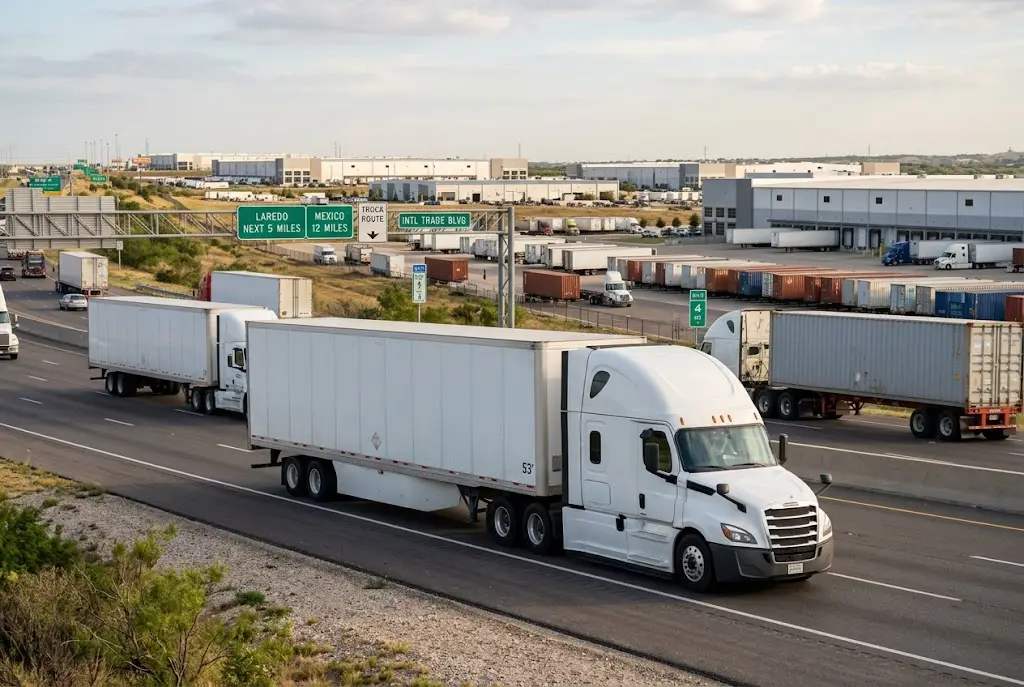
According to the Federal Motor Carrier Safety Administration (FMCSA), FJ Carrier Logistics LLC has an active USDOT registration and is authorized for motor-carrier operations involving property other than household goods. The FMCSA record identifies the company at 13911 Copper Drive in Laredo, Texas, with 230 power units and 330 drivers in its current company snapshot. FMCSA’s carrier record provides the current regulatory information.
Laredo’s position on the U.S.-Mexico border makes cross-border freight an important part of the region’s logistics ecosystem. FJ Carrier Logistics has also appeared in industry transportation networks and was recognized by Transplace in its 2022 Carrier Symposium as a cross-border carrier award recipient for Mexico.
This guide examines FJ Carrier Logistics, its operating profile, the role of Laredo in freight transportation, cross-border logistics considerations, technology, fleet operations, and the factors businesses should evaluate when selecting a carrier.
What Is FJ Carrier Logistics?
FJ Carrier Logistics LLC is an interstate freight carrier based in Laredo, Texas. Its FMCSA registration identifies the company as a carrier transporting general freight and lists USDOT number 3162922 and MC number 112466. The current FMCSA snapshot shows the USDOT status as active and the operating authority as authorized for motor carrier property operations other than household goods.
The company’s location is significant because Laredo is one of the most important freight gateways between the United States and Mexico. For shippers, transportation providers operating from this market can play an important role in connecting domestic freight movements with cross-border supply chains.
Where Is FJ Carrier Logistics Located?
FJ Carrier Logistics is listed at 13911 Copper Drive, Laredo, Texas 78045. Laredo’s location on the Texas-Mexico border provides access to a major commercial corridor supporting manufacturing, automotive, retail, industrial, and general freight movements.
The location can be particularly relevant for companies whose supply chains involve Mexico-based manufacturing or distribution. A carrier positioned in the Laredo market can potentially support freight flows that require coordination between domestic transportation and international border processes.
What Does FJ Carrier Logistics Transport?
FMCSA’s current carrier snapshot identifies general freight as the company’s cargo category. This broad classification covers a wide range of commercial goods rather than limiting the carrier to a single specialized commodity.
Businesses evaluating a carrier should still confirm the specific equipment, commodity requirements, lane availability, insurance, scheduling, and handling capabilities needed for an individual shipment.
FJ Carrier Logistics and Cross-Border Freight
Cross-border transportation requires more than simply moving a trailer from one country to another. Shipments can involve customs documentation, broker coordination, border procedures, appointment scheduling, carrier communication, and accurate shipment information.
Laredo is particularly important in this environment because of its role as a major U.S.-Mexico trade gateway. FJ Carrier Logistics’ industry recognition as a cross-border carrier for Mexico further connects the company with this transportation segment.
For shippers, the key issue is not simply whether a carrier operates near the border. The carrier’s ability to coordinate schedules, communicate accurately, maintain shipment visibility, and work effectively with the relevant parties can have a major effect on overall transportation performance.
Why Laredo Matters to the Supply Chain
Laredo occupies a strategic position in North American trade. Companies with manufacturing and distribution operations in Mexico often need reliable transportation connections into U.S. distribution networks.
A typical cross-border freight flow may involve:
- Goods leaving a manufacturing or supplier location.
- Transportation toward the border.
- Customs and documentation processes.
- Border crossing and carrier coordination.
- U.S. domestic transportation.
- Delivery to a warehouse, distribution center, or customer.
Each stage introduces potential delays. Transportation providers therefore contribute to supply-chain performance not only through driving capacity but also through scheduling, communication, documentation, and operational coordination.
FJ Carrier Logistics Fleet and Operating Scale
The current FMCSA company snapshot lists 230 power units and 330 drivers for FJ Carrier Logistics. The same record reports more than 37.4 million miles for the 2025 mileage year.
Fleet size is useful when evaluating transportation capacity, but it should not be treated as a guarantee that equipment will be available for every lane or shipment. Availability can depend on demand, location, equipment type, driver schedules, and existing customer commitments.
Businesses should therefore confirm current capacity directly when planning recurring or time-sensitive freight.
Dry Van and General Freight Transportation
Industry carrier information identifies FJ Carrier Logistics with dry-van equipment and full-truckload shipment activity. CarrierSource also identifies cross-border operations among its specialized services.
Dry-van transportation is widely used for packaged and palletized freight that does not require temperature-controlled equipment. It can be suitable for many general manufacturing, consumer-product, retail, and industrial shipments.
For a shipper, equipment suitability should always be confirmed based on the commodity, dimensions, loading method, security requirements, and destination.
Full Truckload Transportation
Full truckload (FTL) transportation is generally used when a shipment requires most or all of a trailer’s capacity or when the shipper wants a more direct movement between origin and destination.
FTL can offer several operational advantages:
- Fewer intermediate handling points.
- Direct transportation between designated locations.
- Better control over shipment scheduling.
- Potentially shorter transit times than multi-stop freight.
- Reduced exposure to repeated loading and unloading.
Whether FTL is the best choice depends on shipment volume, urgency, lane, pricing, and delivery requirements.
Technology and Shipment Visibility
Modern freight transportation increasingly depends on digital visibility. Shippers want to know where their freight is, whether it is progressing according to schedule, and when delivery is expected.
CarrierSource currently identifies electronic tracking among FJ Carrier Logistics’ operating capabilities. Its available carrier profile reports that reviewers indicated electronic tracking was used.
Electronic tracking can help transportation teams monitor shipments and communicate more effectively with customers. However, the usefulness of tracking depends on the technology deployed, data accuracy, coverage, and how actively the information is incorporated into operations.
Why Communication Matters in Freight Transportation
Transportation is a coordination business. A shipment can be physically ready while still being delayed by incomplete instructions, appointment issues, border documentation, driver availability, or changes at the receiving facility.
Effective communication between shippers, brokers, drivers, dispatchers, warehouses, customs professionals, and receivers helps reduce these operational gaps.
CarrierSource’s current profile includes reviews mentioning timely pickup and delivery, while also showing that communication and tracking performance can vary by shipment experience.
For businesses considering a carrier, this is a useful reminder to evaluate actual service requirements and establish clear communication procedures before tendering important freight.
How FJ Carrier Logistics Fits Into a Supply Chain
A carrier is one component of a broader supply-chain system. Even a reliable trucking company cannot independently control customs processing, warehouse congestion, manufacturing schedules, weather, traffic, or receiver delays.
A broader supply chain may involve:
- Manufacturers.
- Suppliers.
- Freight brokers.
- Motor carriers.
- Customs brokers.
- Warehouses.
- Distribution centers.
- Retailers.
- Final customers.
Transportation efficiency improves when these parties have accurate information and coordinated schedules.
Benefits of a Strong Carrier Relationship
More Predictable Transportation
A consistent carrier relationship can help businesses understand lane performance, transit expectations, capacity patterns, and communication procedures.
Better Operational Planning
Reliable transportation information makes it easier for warehouses and distribution centers to schedule receiving and outbound operations.
Improved Shipment Visibility
Digital tracking and timely status updates can give logistics teams greater visibility into transportation progress.
Potentially Lower Administrative Friction
When a shipper and carrier understand each other’s procedures, fewer questions and corrections may be required during routine shipments.
What Businesses Should Consider Before Choosing a Carrier
FJ Carrier Logistics may be relevant to shippers evaluating general freight and cross-border transportation, but businesses should conduct their own carrier qualification process before awarding freight.
Lane Coverage
Confirm that the carrier regularly serves the required origin and destination markets and can provide capacity when needed.
Equipment
Confirm that the carrier can provide the appropriate trailer and equipment for the shipment.
Insurance
Review the carrier’s current insurance information and verify that coverage is appropriate for the value and type of cargo being transported.
Safety and Regulatory Status
Use official FMCSA information to verify the carrier’s current registration, authority, and available safety information before entering a transportation agreement.
Tracking
Ask how shipment tracking works, what information is available, and how frequently shipment status is updated.
Cross-Border Experience
If freight crosses the U.S.-Mexico border, confirm the carrier’s experience with the specific lane and operational process required for the shipment.
FJ Carrier Logistics and Supply Chain Efficiency
The phrase “supply chain efficiency” involves much more than transportation speed. Efficient logistics aims to move goods reliably while balancing transit time, capacity, cost, inventory requirements, and customer expectations.
A carrier can contribute by providing dependable capacity, maintaining communication, reducing unnecessary delays, and supporting shipment visibility.
For shippers operating cross-border supply chains, these factors can become especially important because a delay at one stage can affect warehouse schedules and downstream customer commitments.
How to Evaluate FJ Carrier Logistics for Your Shipment
- Define the lane: Identify exact pickup and delivery locations.
- Describe the freight: Provide commodity, weight, dimensions, and packaging information.
- Specify equipment: Confirm the required trailer type.
- Clarify timing: Establish pickup windows and delivery requirements.
- Identify border requirements: For international shipments, establish the customs and documentation responsibilities of each party.
- Request pricing: Compare the transportation quote with alternative carrier options.
- Confirm tracking: Establish how shipment visibility will be provided.
- Verify compliance: Review current FMCSA information and insurance documentation.
- Evaluate service history: Consider available performance information and your own shipment experience.
FJ Carrier Logistics vs. a Broader Logistics Provider
A motor carrier and a third-party logistics provider (3PL) do not necessarily perform the same role.
A motor carrier physically transports freight using its operating equipment and drivers. A 3PL may coordinate transportation across multiple carriers and services, depending on its business model.
For a shipper, the best choice depends on how much transportation management it wants to handle internally. A direct carrier relationship may provide a straightforward connection for recurring lanes, while a broader logistics provider may be useful when a company needs multi-carrier coordination.
The Role of Logistics Technology
Transportation management technology continues to influence how businesses plan and monitor freight. Routing tools, electronic tracking, digital documentation, automated notifications, and transportation-management systems can reduce manual work and improve information flow.
Technology is most useful when it supports sound operational processes. A tracking platform cannot compensate for poor planning, inaccurate shipment information, or inadequate communication.
For this reason, companies should evaluate both the technology and the people responsible for using it.
Related Logistics and Supply Chain Resources
FreshDell’s logistics coverage also includes 92A Automated Logistical Specialist, which examines military supply and inventory operations, and DRF Logistics, which explores another logistics and supply-chain business.
For a broader look at modern warehousing and distribution infrastructure, readers can also explore Arden Logistics Parks. These related articles help place freight transportation within the larger logistics ecosystem.
Frequently Asked Questions About FJ Carrier Logistics
What is FJ Carrier Logistics?
FJ Carrier Logistics LLC is an interstate motor carrier based in Laredo, Texas. FMCSA currently lists the company as active and authorized for property motor-carrier operations other than household goods.
Where is FJ Carrier Logistics located?
The current FMCSA company record lists FJ Carrier Logistics LLC at 13911 Copper Drive, Laredo, Texas 78045.
What type of freight does FJ Carrier Logistics handle?
FMCSA identifies general freight as the company’s cargo category. CarrierSource additionally identifies dry-van and full-truckload operations in its current carrier profile.
Does FJ Carrier Logistics operate cross-border?
Available industry information identifies cross-border transportation as part of the company’s operating profile, particularly involving Mexico. FJ Carrier Logistics was also recognized in Transplace’s 2022 carrier awards for cross-border transportation involving Mexico.
What is FJ Carrier Logistics’ USDOT number?
FJ Carrier Logistics LLC’s current FMCSA record identifies its USDOT number as 3162922 and its MC number as 112466.
Does FJ Carrier Logistics offer shipment tracking?
CarrierSource currently identifies electronic tracking among the company’s listed capabilities. Shippers should confirm the exact tracking functionality and availability for their specific shipment or lane.
Final Thoughts
FJ Carrier Logistics operates from one of North America’s most strategically important freight locations. Its Laredo base, active FMCSA status, general-freight authority, fleet scale, and cross-border operating profile make it relevant to businesses evaluating transportation options connected with U.S.-Mexico supply chains.
However, selecting a carrier should involve more than looking at company size or location. Shippers should evaluate lane coverage, equipment, pricing, insurance, regulatory status, tracking capabilities, communication, and actual service requirements.
For companies moving freight through Laredo or other North American trade corridors, a well-qualified carrier can become an important part of a reliable supply-chain strategy. The strongest transportation relationships are built around accurate information, clear expectations, operational visibility, and consistent execution.
For more FreshDell logistics content, continue with our guides to 92A Automated Logistical Specialist, DRF Logistics, and Arden Logistics Parks.