

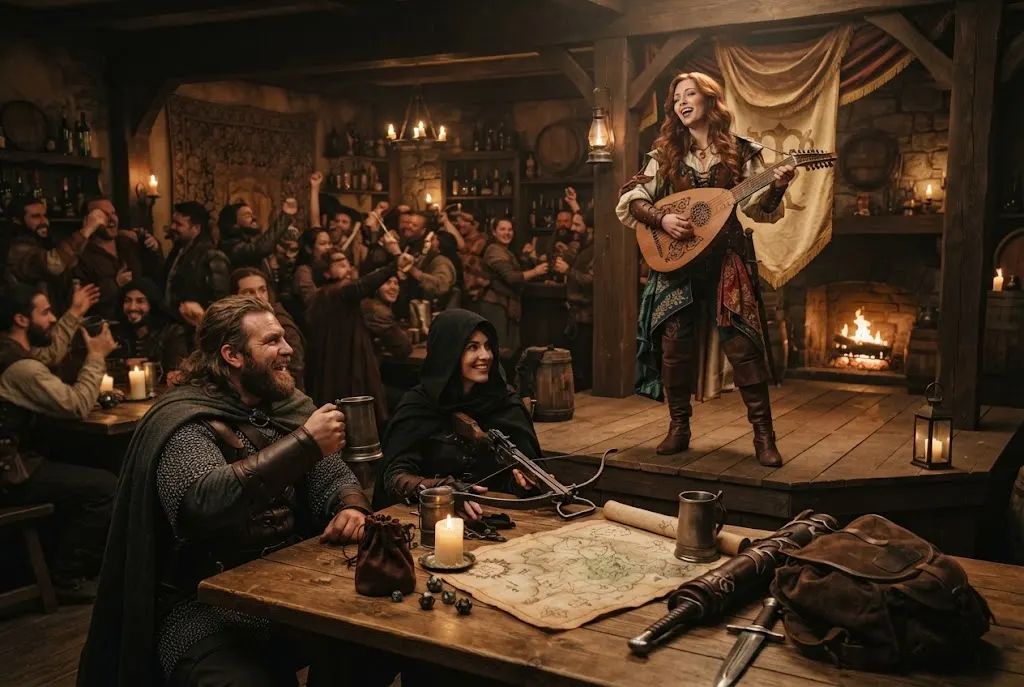
The D&D Entertainer background is an excellent choice for players who want a character built around performance, creativity, social interaction, and a memorable personal history. An entertainer does not have to be a traditional musician or bard. Your character could be an actor, dancer, acrobat, storyteller, comedian, circus performer, street artist, or another type of adventurer who learned to command an audience.
What makes the background especially useful is the way it connects a character’s past to the way they behave during an adventure. Performance can become part of exploration, social encounters, negotiations, distractions, and roleplaying rather than simply something your character does between battles.
What Is the D&D Entertainer Background?
In Dungeons & Dragons, a background describes important experiences and activities from a character’s life before becoming an adventurer. The Entertainer background represents someone who has spent time performing for audiences and developed abilities connected with entertaining others.
The exact mechanical details depend on which ruleset you are using. D&D Beyond currently distinguishes the newer Entertainer background from the legacy 2014 version. In the newer rules, Entertainer is associated with the Musician Origin feat and Acrobatics and Performance skills. The 2014 version is presented separately as a legacy option. D&D Beyond’s background listings provide the current distinction between these versions.
For players using a specific campaign rulebook, the best approach is to use the background version supported by the Dungeon Master and the books being used for character creation.
Why Choose an Entertainer for Your Character?
The Entertainer background gives you a strong foundation for a character who contributes through personality as much as combat ability. It can work particularly well when your campaign includes taverns, festivals, noble courts, theaters, traveling performers, marketplaces, guilds, or other locations where social interaction matters.
An entertainer can also add variety to a party. Instead of solving every problem with weapons or spells, your character may attempt to distract a guard, perform for a suspicious crowd, negotiate with a host, or use a public performance to create an opportunity for the rest of the group.
This makes the background valuable for players who enjoy improvisation and character-driven storytelling.
Entertainer Skills: Acrobatics and Performance
One of the defining elements of the current Entertainer background is its connection to Acrobatics and Performance. These skills support two different sides of the entertainer concept.
Acrobatics
Acrobatics can reinforce a character who performs through movement, balance, agility, tumbling, dance, or physical showmanship. A performer might have learned these abilities on a stage, in a circus, during street performances, or while traveling with an entertainment troupe.
This also gives you an opportunity to create a character whose physical style is part of their identity. A dancer could move with unusual grace, while an acrobat might incorporate flips and daring movements into their adventuring persona.
Performance
Performance represents the character’s ability to entertain an audience through an appropriate artistic expression. Depending on your character concept, that could involve music, acting, storytelling, dance, comedy, poetry, or another form of performance.
The important point is that Performance does not have to mean standing on a stage and singing. Think about what your character considers art and how they learned to present it to other people.
How to Create a Strong Entertainer Backstory
A memorable entertainer needs more than a profession. The strongest backstories explain why the character became a performer and how that experience shaped their personality.
Start by answering a few simple questions:
- Where did your character learn to perform?
- Who was their first audience?
- Was performing a passion, a profession, or a means of survival?
- Did they belong to a traveling troupe?
- Did a mentor teach them their craft?
- Why did they eventually leave their previous life?
- What does their character fear about performing?
- What does success on stage mean to them?
These questions can turn a generic performer into a character with believable motivations and useful roleplaying hooks.
Entertainer Character Ideas
You do not need to limit the background to a stereotypical bard. Consider one of these concepts instead:
The Traveling Storyteller
This character moves from town to town collecting legends, rumors, and local stories. Their performances provide entertainment, but their real interest is learning what people know.
The Circus Acrobat
A character raised around performers may have learned balance, movement, stagecraft, and crowd control from childhood. Their adventuring career could begin when the troupe encounters a dangerous mystery or separates unexpectedly.
The Street Performer
A street performer might have learned to read crowds quickly and make money wherever an audience gathers. This creates natural connections to busy cities, markets, festivals, and taverns.
The Court Performer
This character entertained nobles and learned that performances can reveal much about politics and social relationships. Their background could provide a natural reason for knowing etiquette, gossip, and influential figures.
The Traveling Musician
A musician can make their instrument central to their identity without making every scene about music. Their instrument can represent family history, a former mentor, an old troupe, or an unfinished personal ambition.
Choosing a Performance Style
One of the easiest ways to make an Entertainer character distinctive is to choose a specific performance style.
| Performance Style | Possible Character Flavor |
|---|---|
| Music | Instrumentalist, singer, traveling musician |
| Dance | Agile performer, cultural dancer, theatrical artist |
| Acting | Stage actor, impersonator, dramatic performer |
| Comedy | Jester, storyteller, witty tavern performer |
| Acrobatics | Circus performer, tumbler, stunt artist |
| Storytelling | Legend keeper, traveling chronicler, oral historian |
The best choice is the one that gives you ideas for scenes. If you can immediately imagine how your character would react when entering a crowded tavern or meeting a powerful noble, the concept is probably working.
Using Performance During Adventures
The Entertainer background becomes much more interesting when performance is treated as a roleplaying tool rather than a decorative detail.
A performance might attract attention while another party member investigates something nearby. Your character might entertain guests at a formal gathering, tell stories to gain goodwill, or create a memorable introduction when the party arrives in a new settlement.
Performance can also create opportunities for the Dungeon Master to introduce information. A character who spends time entertaining people may naturally encounter rumors, local traditions, traveling merchants, performers, or other NPCs.
However, performance should not automatically replace every other skill or ability check. The Dungeon Master determines when a particular approach is appropriate and which ability or skill applies to the situation.
Making the Entertainer Useful in a Party
An Entertainer can become a valuable member of a party by supporting the group’s social and narrative goals.
- During social encounters: help establish rapport and keep conversations moving.
- During exploration: use character knowledge and social connections to gather context.
- During investigations: interact with NPCs who may respond better to a performer than an armed adventurer.
- During downtime: give the character a believable activity that connects them to the setting.
- During travel: use performances to make the character’s profession visible within the world.
The goal is not to make the entertainer the center of every scene. Instead, use the character’s talents to give the whole party additional ways to approach problems.
Entertainer Background and Character Class
The Entertainer background can fit naturally with a Bard, but you do not have to choose Bard simply because your character performs.
A Rogue could be a stage performer who learned to use deception and agility while working in theaters. A Fighter might have spent years performing in competitive exhibitions. A Wizard could have entertained audiences with magical demonstrations before becoming an adventurer. Even a Cleric could have a history as a traveling performer connected to a religious tradition.
This is where background and class become useful together: the background explains what the character did before adventuring, while the class helps explain what they can do as an adventurer.
How to Give Your Entertainer More Personality
Personality is often what separates a memorable entertainer from a collection of skill proficiencies.
Give your character habits that come from their former profession. Maybe they always introduce themselves dramatically. Perhaps they rehearse important conversations before having them. They could instinctively look for an audience whenever they enter a new town.
You can also give the character a weakness. Maybe they cannot resist showing off, become uncomfortable when ignored, or struggle to distinguish genuine friendship from audience approval.
Small details like these create recurring roleplaying opportunities without requiring complicated mechanics.
Common Mistakes When Playing an Entertainer
Making Every Scene a Performance
Your character can be a performer without constantly demanding an audience. Let the profession influence the character naturally rather than forcing it into every interaction.
Ignoring the Rest of the Party
A strong entertainer creates opportunities for other characters. Use social scenes to help the entire group rather than turning every conversation into a solo performance.
Confusing Flavor With Automatic Mechanical Benefits
A creative description does not automatically grant a mechanical advantage. Work with the Dungeon Master to determine what a performance accomplishes and which game mechanics apply.
Choosing a Backstory Without a Reason to Adventure
The character still needs a reason to leave their previous life. A broken troupe, personal ambition, family mystery, failed performance, dangerous patron, or desire to find a legendary stage can provide a compelling starting point.
Entertainer Background Ideas for Different Campaigns
The background can adapt to almost any campaign tone.
In a lighthearted campaign, your entertainer might be an eccentric comedian who collects strange stories. In a serious political campaign, the character could be a former court performer who understands how information travels through elite circles. In a dark fantasy campaign, the entertainer might have performed for audiences who were far more dangerous than they appeared.
For a highly adventurous campaign, the performer could have joined the party because they wanted stories worthy of their greatest performance yet.
You can also draw inspiration from FreshDell’s broader exploration of creativity in problem-solving when thinking about how your character approaches challenges differently.
Using the Entertainer Background for Better Roleplaying
The real strength of the Entertainer background is the number of questions it creates. Who taught your character? Who remembers them? Who dislikes their performances? Who owes them a favor? What performance are they most proud of? What happened to the audience that changed their life?
These questions can become plot hooks for an entire campaign.
You can also connect your character’s performance history to creative interests beyond the game. FreshDell’s guide to developing your inner artist offers another useful angle for thinking about creativity, while its article on abstract art techniques and ideas can inspire unusual artistic concepts for a character.
Related Entertainment and Creative Inspiration
Roleplaying games often borrow ideas from theater, music, visual art, storytelling, and live entertainment. FreshDell’s coverage of Milwaukee’s music scene can provide inspiration for building a character whose identity is strongly connected to live performance.
For characters with a stronger theatrical identity, you can also explore the site’s article about costume design and performance. Costumes, props, stage presentation, and visual identity can all help distinguish an entertainer from other adventurers.
If your character’s concept involves media, storytelling, or popular entertainment, related topics such as cinematic entertainment and Amblin entertainment and movies can also spark ideas for tone, character presentation, and narrative themes.
Frequently Asked Questions
Is the D&D Entertainer background good for a Bard?
Yes. Entertainer naturally fits a Bard because both concepts can emphasize performance and social interaction. However, the background is not limited to Bards and can work with many other classes.
What skills does the Entertainer background provide?
In the current Player’s Handbook version, D&D Beyond lists Acrobatics and Performance for Entertainer. The legacy 2014 version is listed separately, so players should make sure they are using the correct rules version for their campaign.
Does an Entertainer have to play a musical instrument?
No. Music is one possible interpretation of the background, but an entertainer can specialize in acting, dance, comedy, storytelling, acrobatics, or another suitable performance style.
Is Entertainer only useful for roleplaying?
No. Its skills and background features can have mechanical value, but their usefulness depends on the character build, campaign, and situations created by the Dungeon Master.
Can any D&D class use the Entertainer background?
The background is not inherently restricted to the Bard class. A character can combine an entertainer’s previous profession with many different adventuring classes to create a more distinctive history.
Final Thoughts
The D&D Entertainer background works best when it becomes part of the character’s identity rather than simply another entry on a character sheet. Performance, Acrobatics, creativity, social awareness, and a strong personal history can give your adventurer many different ways to interact with the world.
Whether you create a traveling musician, circus acrobat, theatrical performer, street storyteller, comedian, or completely unconventional artist, the background gives you a useful framework for building a character with a life before the campaign began.
Choose a performance style, create a reason your character became an adventurer, connect their past to the campaign setting, and give them a few personality traits that naturally emerge from their life as a performer. That is where the Entertainer background can become more than a rules choice—it can become the foundation for a character your entire table remembers.