

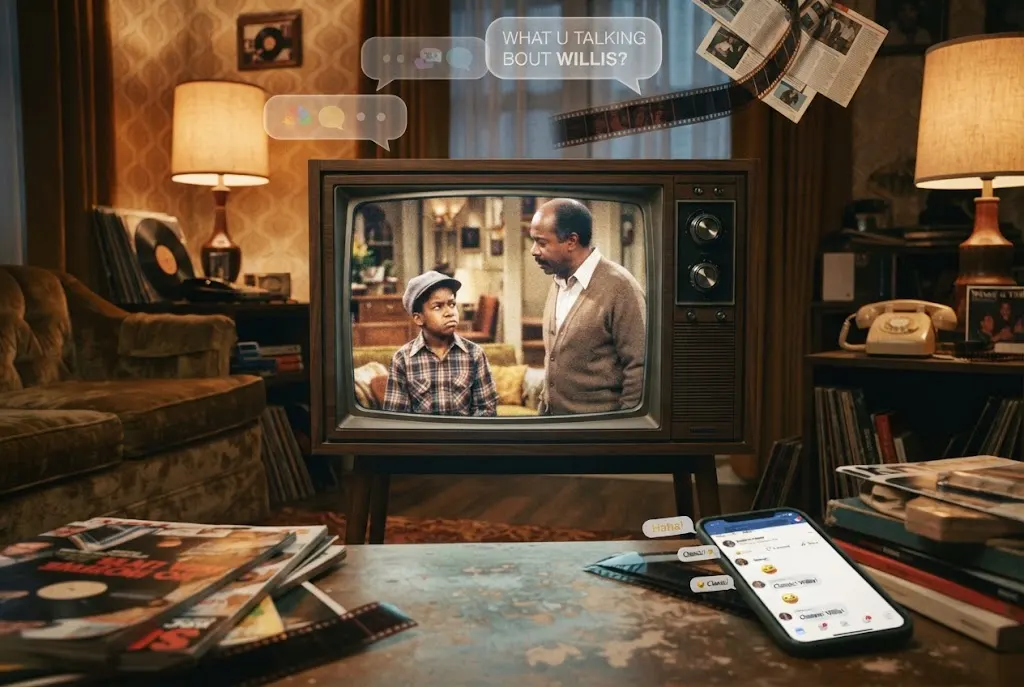
The phrase “WhatUTalkingBoutWillis” is instantly recognizable to many fans of classic American television. Searchers may encounter it today alongside terms such as entertainment Disney movie WhatUTalkingBoutWillis, streaming, movies, and viral entertainment, but the original cultural reference is not a Disney movie. The phrase became famous through the classic sitcom Diff’rent Strokes, where Gary Coleman’s character Arnold Jackson repeatedly directed the line toward his older brother, Willis.
That distinction matters because internet articles and social posts can sometimes turn a familiar phrase into an apparently new movie title. A better way to understand the keyword is to examine the phrase’s television origins, cultural staying power, and why it continues to appear in modern entertainment discussions.
What Does “WhatUTalkingBoutWillis” Mean?
“WhatUTalkingBoutWillis” is a stylized internet form of the famous phrase “What you talkin’ ’bout, Willis?” The wording expresses disbelief, confusion, surprise, or playful disagreement.
The phrase became closely associated with Arnold Jackson, the character played by Gary Coleman on Diff’rent Strokes. The sitcom premiered in 1978 and centered on the relationship between Arnold, his brother Willis, and their family. The catchphrase eventually became one of Arnold’s defining characteristics.
Because catchphrases can survive long after their original shows end, the wording continues to appear in memes, social posts, entertainment articles, jokes, GIFs, and nostalgic references.
Is WhatUTalkingBoutWillis a Disney Movie?
There is no reliable official evidence that a Disney feature film titled “WhatUTalkingBoutWillis” exists. The phrase should therefore not be presented as the title of a confirmed Disney theatrical or streaming movie without an authoritative announcement.
This is particularly important for entertainment publishing. A page can rank for a search phrase without repeating an unverified claim as fact. Instead, the topic can address the searcher’s likely intent: understanding where the phrase came from, why it is associated with entertainment, and how it continues to circulate online.
Disney is certainly a major force in movies, animation, family entertainment, and popular culture, but that does not make every entertainment phrase appearing beside “Disney movie” an official Disney property.
The Television Origin of the Famous Phrase
The phrase became famous through Diff’rent Strokes, the sitcom that introduced audiences to Arnold and Willis Jackson. Gary Coleman played Arnold, while Todd Bridges played Willis.
Arnold’s distinctive delivery helped turn a simple expression of disbelief into a recognizable piece of television language. The phrase worked because it was short, memorable, character-specific, and easy for viewers to repeat.
That combination is important in understanding why certain lines from television become cultural catchphrases. A phrase does not necessarily need a complicated meaning. Repetition, timing, personality, and audience familiarity can be enough to make it memorable.
Why the Phrase Became So Memorable
Several factors helped make “What you talkin’ ’bout, Willis?” more than an ordinary line of dialogue.
A Distinctive Delivery
Gary Coleman’s performance gave the phrase its personality. The expression was not simply about the words. Its timing, facial expression, and delivery became part of the joke.
A Strong Character Association
The line was strongly connected with Arnold Jackson. When audiences heard the phrase, they could immediately associate it with the character and the show.
Simple Language
The wording is easy to remember and adapt. That makes it suitable for imitation, parody, casual conversation, and later internet culture.
Built-In Humor
The phrase naturally communicates confusion or disbelief. That makes it useful whenever someone encounters an unexpected statement or situation.
From Television Catchphrase to Internet Expression
Entertainment culture has changed dramatically since Diff’rent Strokes first aired, but memorable phrases can move easily between generations and platforms.
Today, a phrase like WhatUTalkingBoutWillis can appear as a hashtag, username, meme caption, search term, article keyword, reaction phrase, or social-media joke. Its meaning remains broadly recognizable even when the original television context is not.
This is one reason older television catchphrases continue to have value in digital entertainment. A short line can become a cultural shortcut for an entire character, show, or era.
What Makes a Catchphrase Last for Decades?
The survival of “What you talkin’ ’bout, Willis?” illustrates several characteristics shared by long-lasting entertainment catchphrases.
- Memorable wording: The phrase is short and easy to repeat.
- Distinctive delivery: The original performance gives the words personality.
- Strong character connection: Arnold Jackson became inseparable from the line.
- Flexible meaning: People can use it to express surprise, disbelief, or confusion.
- Easy adaptation: The wording can be modified for jokes, memes, and contemporary conversations.
- Nostalgia: Older viewers recognize it immediately, while younger audiences can discover it through clips and references.
Why People May Associate the Phrase With Disney
The confusion around an “Entertainment Disney Movie WhatUTalkingBoutWillis” search can be understood in the broader context of modern entertainment discovery.
Disney has a huge presence in family movies, animation, streaming, merchandising, and popular culture. Search engines also connect related entertainment concepts based on user behavior and online content. As a result, an unrelated phrase can sometimes appear next to a major entertainment brand in search queries.
That association does not automatically establish an official connection.
For readers researching a movie, the safest approach is to distinguish between an established film, a fan-created concept, an internet rumor, a search phrase, and a genuine studio announcement.
WhatUTalkingBoutWillis and Modern Nostalgia
Nostalgia is one of the strongest forces keeping older entertainment references alive. Viewers often rediscover classic television through streaming platforms, short video clips, social media, compilation videos, and conversations about iconic characters.
The phrase can therefore function as a bridge between classic television and modern digital culture. Someone who has never watched the complete series may still recognize the wording because it has been repeated and referenced for decades.
This pattern can be seen across entertainment. A character, quote, theme song, costume, or visual style can outlive the original production and become part of a much broader cultural vocabulary.
Catchphrases, Memes, and Social Media
Modern social platforms have made it easier for old entertainment references to return to public attention.
A short clip can introduce a classic character to millions of people who were not alive when the original show aired. A meme can then transform a line of dialogue into a reaction format. Once that happens, the phrase can become detached from its original scene while still retaining enough of its original identity to be recognizable.
WhatUTalkingBoutWillis fits naturally into this environment because the phrase already communicates a complete reaction. It can be used whenever someone wants to question an unusual claim, unexpected statement, or confusing situation.
The Difference Between a Search Trend and a Movie
This distinction is particularly useful for entertainment readers.
A search query can become popular because people are discussing a rumor, a meme, an old television show, a fictional concept, or a newly created piece of online content. Search volume alone does not prove that a movie exists.
Before describing a supposed movie as an official production, readers should look for evidence such as an official studio announcement, a verified film listing, recognized production credits, or a legitimate distribution page.
This approach is especially important when a page contains claims about release dates, cast members, box-office performance, reviews, merchandise, or streaming availability.
How Entertainment Articles Can Avoid Misinformation
Entertainment websites often have to balance search demand with factual accuracy. A keyword may suggest a particular story, but the article should not invent details simply to satisfy the wording of the query.
A stronger approach is to explain what can actually be established. In this case, that means discussing the historical phrase, its connection to Diff’rent Strokes, its cultural significance, and the reasons it can appear in modern entertainment searches.
This approach also creates more durable content. Instead of depending on an unverified movie claim, the article can remain useful to readers searching for the phrase years later.
Entertainment Beyond One Movie or Franchise
Modern entertainment is built from many overlapping forms of storytelling. Television, movies, music, theater, gaming, visual design, and online media continuously influence one another.
Readers interested in the broader creative side of entertainment can also explore FreshDell’s coverage of the D&D Entertainer background, which shows how performance and storytelling can shape a fictional character.
For another perspective on film history, FreshDell also covers Amblin Entertainment movies and other subjects connected with cinematic culture.
Visual storytelling extends beyond film as well. Articles covering abstract art techniques and creative artistic expression provide additional context for understanding how visual ideas can communicate emotion and identity.
Why Classic Television Still Matters
Classic television remains relevant because its characters and phrases can become cultural reference points. Even when audiences discover them decades later, the strongest ideas can feel immediately familiar.
“What you talkin’ ’bout, Willis?” is a good example. Its continued recognition demonstrates how performance, character, repetition, and humor can transform ordinary dialogue into a lasting entertainment reference.
The phrase also reminds us that entertainment history is not limited to blockbuster movies. Sitcoms, television characters, comedy routines, and memorable lines can have an equally important role in shaping popular culture.
Frequently Asked Questions
Is WhatUTalkingBoutWillis an actual Disney movie?
No verified Disney movie by that title has been established. The phrase is best known as the catchphrase associated with Arnold Jackson in Diff’rent Strokes.
Where did “What you talkin’ ’bout, Willis?” come from?
The phrase became famous through Diff’rent Strokes, where Gary Coleman played Arnold Jackson and Todd Bridges played his brother Willis.
Who said “What you talkin’ ’bout, Willis?”
Gary Coleman’s character Arnold Jackson was closely associated with the phrase on Diff’rent Strokes.
Why is WhatUTalkingBoutWillis still popular?
The phrase remains recognizable because of its memorable delivery, strong association with a classic television character, humorous meaning, and continued use in internet culture.
Is WhatUTalkingBoutWillis related to Disney?
The phrase itself is not a Disney-created catchphrase. Its established television origin is Diff’rent Strokes. Any claimed Disney movie connection should be independently verified before being presented as fact.
Final Thoughts
The search phrase Entertainment Disney Movie WhatUTalkingBoutWillis may sound like the title of a modern Disney production, but the verifiable story is more interesting: it leads back to one of television’s most recognizable catchphrases.
Rather than treating an unverified movie claim as fact, it is more useful to understand how “What you talkin’ ’bout, Willis?” moved from Diff’rent Strokes into broader popular culture. The phrase demonstrates the lasting power of character-driven comedy and shows how a few memorable words can survive long after the original television episode has ended.
For entertainment readers, that history is a useful reminder that cultural impact does not always come from a new blockbuster. Sometimes, it comes from a single character, a distinctive delivery, and a line that audiences never quite forget.